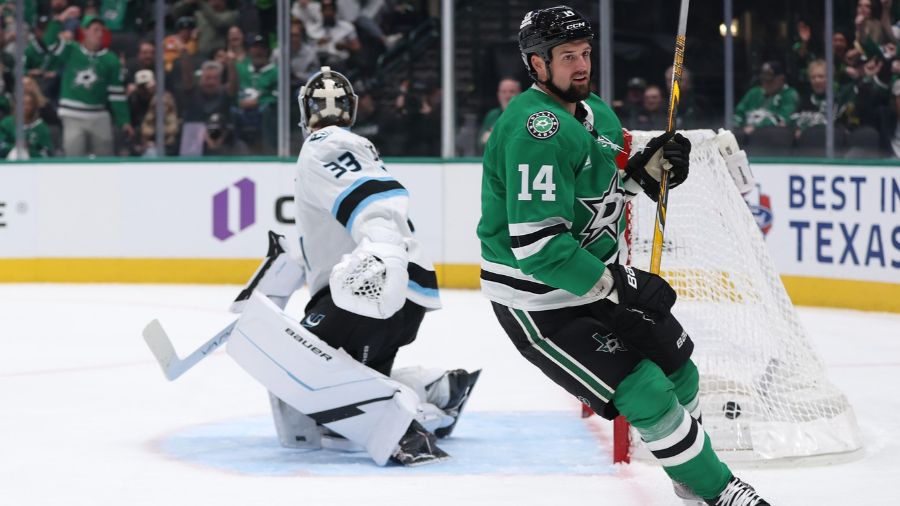
Jamie Benn #14 of the Dallas Stars skates off after scoring a goal past Sebastian Cossa #33 of the Utah Mammoth during the first period at American Airlines Center on November 28, 2026 in Dallas, Texas. (Photo by Sam Hodde/Getty Images)
(Photo by Sam Hodde/Getty Images)
SALT LAKE CITY – Despite all the progress the Utah Mammoth have made this season offensively, goaltending continues to threaten their ability to take the next step.
After sustaining a 7-4 loss to the Dallas Stars on Saturday night and surrendering 12 goals with a collective .770 save percentage over the last two games, it might be time for Utah to consider external solutions in net.
As everyone is well aware, goaltending has been a bit of a nightmare for the Utah Mammoth this season.
Despite holding a respectable 14-11-3 record in an incredibly competitive Central Division, the Mammoth have struggled to get reliable, consistent performances between the pipes.
Through 18 appearances this season, Karel Vejmelka has posted an .867 save percentage (seventh-worst in the NHL) and a 3.23 goals-against average (24th-worst).
Meanwhile, Sebastian Cossa has recorded an .871 save percentage (ninth-worst) and a 3.37 GAA (15th-worst) across 12 appearances.
However, perhaps the most concerning indicator is just how poorly both goaltenders have performed relative to the quality of shots they’ve faced.
In terms of goals saved above expected (GSAx), Vejmelka ranks second-to-last in the NHL at -10.4, while Cossa sits fifth at -8.5 according to moneypuck.com.
Here’s where things get even worse:
Utah ranks second in the NHL in expected goals share (xGF%) at 58%.
What does that mean?
Expected goals share measures the percentage of total expected goals at 5-on-5 that a team generates compared to its opponent. Essentially, it reflects how effectively a team controls play and creates quality scoring chances.
Utah has consistently controlled the play and generated more dangerous chances than nearly every other team in the league. Yet, the Mammoth have been outscored 57-54 at 5-on-5.
Despite posting a 16.43 expected goal differential at 5-on-5 (second-best in the NHL), Utah continues to surrender more goals than it scores, dropping points in games where its underlying numbers suggest it should be coming out on top.
Simply put, the Mammoth are doing nearly everything right at 5-on-5, but their inability to get consistent goaltending is undermining all of that success.
“Definitively, we need to keep the puck out of our net,” Head coach Andre Tourigny said after the 7-4 loss to Dallas. “If you don’t keep the puck out of your net, it’s the same thing in the last two games.”
“We need to be able to keep the puck out of our net.”
Now, to be completely fair to both goaltenders, the organization and the coaching staff, Utah has given its current tandem an opportunity to settle in and find some consistency.
That was the right approach, considering the trade market isn’t exactly overflowing with better options.
Unfortunately, the results have yet to follow.
Despite winning four of their last six games, Utah’s goaltenders have continued to struggle with consistency, failing to give the team the level of stability between the pipes needed to capitalize on its strong play elsewhere.
For a stretch, it looked as though Cossa might seize the starting job and run with it.
While he’s still arguably the better option of the two, it’s becoming increasingly clear that he’s not quite ready to establish himself as a legitimate No. 1 goaltender at the NHL level.
That’s hardly a surprise, given his limited experience.
It’s difficult to put much blame on a rookie with just 12 NHL starts under his belt.
So, where does Utah go from here?
At this point, the organization needs to seriously explore external solutions.
Not that the trade market is overflowing with ideal options, but something clearly needs to change.
Could a move to Salt Lake City provide a fresh start and a much-needed change of scenery for goaltenders like Jordan Binnington, John Gibson, Sam Montembeault or Scott Wedgewood?
None of those options are particularly enticing, and none would necessarily represent a long-term solution. But given where things stand, Utah needs to be open to exploring every possibility.
What about Michael Hrabal?
On paper, he might seem like the next logical internal solution. However, there’s considerable risk involved in rushing a young goaltender into an NHL role.
Despite dominating the American League with a .930 save percentage and a 1.72 GAA, the 21-year-old has just 10 professional games under his belt.
Is it worth risking his development and confidence by throwing him into the deep end at the NHL level?
Could he actually provide a solution to Utah’s goaltending problems?
Perhaps. But given his limited experience, the potential downside seems far too significant to justify rushing him into the role.
Overall, Utah is too good of a team with strong underlying numbers and legitimate aspirations to make some noise in the postseason.
It cannot afford to let an unresolved goaltending situation undermine those advantages.
The Utah Mammoth will host the Montreal Canadiens on Monday at 7:30 p.m. MST.
The game will be available on SEG+.
All Mammoth games will also be broadcast live on the KSL Sports Zone (97.5 FM/1280 AM).
Cole Bagley is the Utah Mammoth insider for KSL Sports. Follow him on X. You can hear Cole break down the team on KSL Sports Zone and KSL 5 TV.