‘I don’t want to be predictable’: Mastroeni plots RSL’s next evolution
Jul 22, 2026, 8:29 AM | Updated: 9:38 am
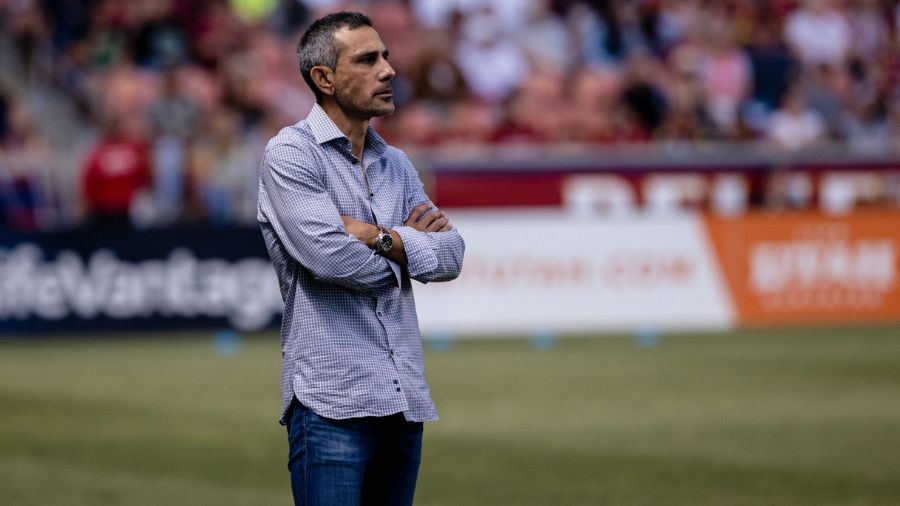
Real Salt Lake manager Pablo Mastroeni watches from the sideline on July 17 in the 3-0 victory against Sporting Kansas City. Photo courtesy: Laura Dearden of Real Salt Lake.

SANDY — Real Salt Lake entered the World Cup break in fine form, collecting 10 points from its final five MLS matches.
Head coach Pablo Mastroeni wasn’t discussing goal-scoring in his last few press conferences; he was concerned about the goals RSL was leaking at the other end.
Mastroeni and his team spent the break refining an increasingly fluid attacking identity while emphasizing the defensive responsibilities incurred the moment possession is lost.
“I feel really good,” Mastroeni said after Monday’s training. “I think we’ve worked on a couple things in the mini-preseason that we’ve had, and the guys have adapted really, really well.”
The first test comes immediately.
RSL traveled to Los Angeles Tuesday before facing LAFC Wednesday night. The club will remain in Southern California to train Thursday morning before flying directly to Portland ahead of Saturday’s match against the Timbers.
For Mastroeni, the challenge extends beyond two difficult road environments.
It’s about proving that the tactical lessons that showed promise during the past six weeks of training and scrimmages will hold up when points are on the line.
“It’ll be good to feel the game differently when the bullets start flying in LAFC,” Mastroeni said. “It’ll be a whole different experience.”
Long road stretch begins in the City of Angels #LAFCvRSL | @Baileys3PL pic.twitter.com/w10UnIMz1F
— Real Salt Lake (@realsaltlake) July 21, 2026
Freedom with responsibility
Following Real Salt Lake’s convincing 4-1 victory over Burnley in a preseason friendly, Mastroeni wasn’t interested in celebrating the scoreline. Instead, he immediately turned the discussion toward transition defense.
“I think offensively as well, there’s way too many rotations,” Mastroeni said after the match. “While it’s good when you keep the ball, when you lose the ball with so many players rotating, you find yourself in dangerous situations in transition.”
He succinctly identified the tradeoff RSL has been living with, and dying with, all season.
Throughout the first half of the year, the Claret-and-Cobalt evolved into one of MLS’s most fluid attacking teams. Rather than occupying rigid positions, players constantly exchanged roles, creating overloads and new passing angles that forced opposing defenses into difficult decisions.
“I don’t want to be predictable,” Mastroeni said Monday.
But the same rotations that unbalance an opponent’s defense can leave RSL exposed when an attack breaks down.
Discussing the lone goal Burnley scored, Mastroeni explained that every positional exchange creates a corresponding defensive responsibility.
“If you’re a 10 and you’re dropping into the pivot line, you have to conduct yourself like a pivot,” he said. “If you’re a 10 and want to rotate out to the wide areas and push the winger higher, the ball gets turned over, you have to conduct yourself defensively as a wingback.”
In other words, the position you start in matters less than the position you occupy when possession changes hands. That concept has become a major focus during the World Cup break.
Teaching principles, not patterns
Monday’s training session revealed the next stage of that evolution.
Rather than asking his players to rotate less, Mastroeni wants them to recognize what those rotations require. Instead of less freedom, he wants to see smarter freedom.
“If Diego rolls out wide and the ball rotates to the other side, Diego now has to take on a central position because if we lose the ball with him standing wide on the other side, the center of the field is naked,” he said. “Now you have Bouanga and Son receiving this ball in dangerous areas.”
For many coaches, the simplest solution would be to eliminate the movement altogether.
Not Mastroeni.
“The easy thing to do would be like no rotations, and now we’ve become a really predictable team,” he said. “I don’t want to be predictable. I want to continue to evolve. I want to see an understanding of our game model, an evolution of our game model, so that we can continue to be this expressive, dynamic attacking team. I don’t want to pull the reins on them. I want them to understand and grow and understand the tactical implications that these rotations have, which are positive on the attack, but could compromise you defensively.”
Mastroeni said the coaching staff begins by giving players an objective and a handful of examples, but the expectation isn’t that they simply copy what they’ve been shown.
“So the way we started in preseason was, ‘This is the objective, and these are a couple ideas,'” Mastroeni said. “But what’s happened since then. … now there’s 10 ideas, right? So when you give them, ‘This is the objective. These are a couple rotations,’ and then they go, ‘But then we see all these other rotations,’ I’m going, ‘That’s brilliant, but now what’s the responsibility for said player when he rotates in that position if we lose the ball?'”
In other words, Mastroeni isn’t trying to choreograph every movement because he’d rather teach players to solve problems.
The coaching staff provides the objective. The players discover new solutions. Then the coaches teach the defensive responsibilities that come with those solutions.
“We create the objective as a staff and the players kind of fill in the how,” Mastroeni said. “We give them the why. This is why we want to do it. These are a couple ideas. But the how is you guys.”
For the coaching staff, that’s the objective. Not for players to memorize patterns, but to understand them well enough to create even better ones.
Reflecting on the closed-door scrimmage at Minnesota, Mastroeni smiled while describing some of the combinations his players created.
“The patterns were better than the patterns we concocted in training,” he said. “The players feel it too.”
The measuring stick
If the World Cup break was spent refining transition defense, Wednesday’s opponent provides a stern examination.
Mastroeni repeatedly described LAFC as “a really good defensive team,” and the numbers support the assessment.
The contrast couldn’t be much sharper. LAFC has recorded 10 clean sheets in its first 15 league matches while conceding just 1.06 goals per game. Real Salt Lake, despite averaging 1.86 goals offensively, has managed only two clean sheets all season.
“They’re a really good defensive team,” Mastroeni said. “They have three difference makers up front that any transition moment becomes a threat.”
Burnley capitalized on one of the transition breakdowns Mastroeni wants to eliminate. An in-form LAFC side on its home field will pose that question repeatedly.
LAFC resumed league play last weekend with a 3-0 victory over the rival LA Galaxy behind goals from Mark Delgado, Denis Bouanga and Son Heung-Min.
Bouanga has made a career punishing open space and remains one of MLS’s most dangerous attackers, while Son finally opened his scoring account after already collecting nine assists during the first half of the season.
Those are precisely the players Mastroeni referenced when discussing defensive balance.
“They’ll defend behind the ball but they’ll break out,” he said. “Transition defending for us is a really important bullet point.”
Defense wins championships
Asked how RSL can improve its road form after earning just one point in its final two away matches before the break, Mastroeni didn’t talk about scoring.
He talked about Spain.
“I brought up with the guys the fact that Spain conceded one goal in the World Cup,” he said. “That’s the stat of the World Cup.”
The lesson wasn’t about replicating their possession stats or tactics. It was about defending every moment, even with an attack built on movement.
Cabral echoed that sentiment.
“If you analyze our season so far, we concede a lot of goals from set pieces, no open play, because we’ve been defending well,” the goalkeeper said. “That’s some point that we know if we improve, we are gonna be even stronger.”
The challenge now is carrying those improvements away from America First Field.
“We have to improve our games away from home and play like we play home,” Cabral said.
After six weeks of work, Mastroeni believes his team has the ideas.
The World Cup break gave Real Salt Lake time to refine an attack built on movement, freedom and unpredictability.
RSL has already demonstrated the efficacy of its attack. The main question Wednesday night: Has the team learned how to defend it consistently over 90 minutes?
RELATED STORIES



How to watch:
Who: Real Salt Lake at LAFC
When: Wednesday, July 22; 8:30 p.m. MT
Where: BMO Stadium, Los Angeles
Watch: MLS Season Pass on AppleTV