Josh Gibson Becomes MLB Batting Leader As Negro Leagues Statistics Incorporated
May 30, 2024, 10:33 AM
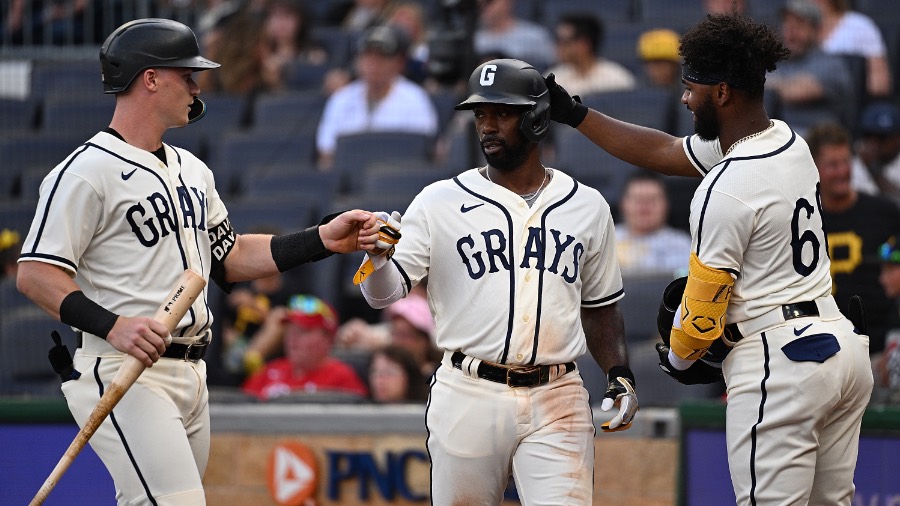
Andrew McCutchen #22 of the Pittsburgh Pirates celebrates with Liover Peguero #60 and Henry Davis #32 after coming around to score in the first inning during game two of a doubleheader against the Cincinnati Reds at PNC Park on August 13, 2023 in Pittsburgh, Pennsylvania. The Pirates are wearing jerseys honoring the Homestead Grays of the Negro League. (Photo by Justin Berl/Getty Images)
(Photo by Justin Berl/Getty Images)

NEW YORK (AP) — Josh Gibson became Major League Baseball’s career leader with a .372 batting average, surpassing Ty Cobb’s .367, when Negro Leagues records for more than 2,300 players were incorporated Tuesday after a three-year research project.
Josh Gibson becomes MLB career and season batting leader
Gibson’s .466 average for the 1943 Homestead Grays became the season standard, followed by Charlie “Chino” Smith’s .451 for the 1929 New York Lincoln Giants. They overtook the .440 by Hugh Duffy for the National League’s Boston team in 1894.
Gibson also became the career leader in slugging percentage (.718) and OPS (1.177), moving ahead of Babe Ruth (.690 and 1.164).
“It’s a show of respect for great players who performed in the Negro Leagues due to circumstances beyond their control and once those circumstances changed demonstrated that they were truly major leaguers,” baseball Commissioner Rob Manfred said Wednesday in an interview with The Associated Press. “Maybe the single biggest factor was the success of players who played in the Negro Leagues and then came to the big leagues.”
Several Major League records are now held by Josh Gibson as he and other Negro Leagues legends officially join the all-time leaderboards.
The statistics of more than 2,300 Negro Leagues players launch today in a newly integrated https://t.co/Z3s2EpgF39 database that presents… pic.twitter.com/UyvCu0pSzi
— MLB (@MLB) May 29, 2024
A special committee on baseball records decided in 1969 to recognize six major leagues dating to 1876: the National (which launched in 1876), the American (1901), the American Association (1882-1891), Union Association (1884), Players’ League (1890) and Federal League (1914-1915). It excluded the National Association (1871-75), citing an “erratic schedule and procedures.”
RELATED STORIES

MLB announced in December 2020 that it would be “correcting a longtime oversight” and would add the Negro Leagues. John Thorn, MLB’s official historian, chaired a 17-person committee that included Negro Leagues experts and statisticians.
“The condensed 60-game season for the 2020 calendar year for the National League and American League prompted us to think that maybe the shortened Negro League seasons could come under the MLB umbrella, after all,” Thorn said.
An updated version of MLB’s database will become public before the St. Louis Cardinals and San Francisco Giants play a tribute game to the Negro Leagues on June 20 at Rickwood Field in Birmingham, Alabama.
Baseball Hall of Fame President Josh Rawitch said statistics on Cooperstown plaques will remain the same because they reflect the information available at the time of a player’s induction.
Standards for season leaders is the same for Negro Leagues as the other leagues: 3.1 plate appearances or one inning for each game played by a player’s team.
Gibson’s .974 slugging percentage in 1937 becomes the season record, and Barry Bonds’ .863 in 2001 dropped to fifth, also trailing Mules Suttles’ .877 in 1926, Gibson’s .871 in 1943 and Smith’s .870 in 1929.
Negro Leagues and D.C. legend Josh Gibson is now @MLB's all-time leader in multiple statistical categories.
Gibson is a member of the Washington Nationals Ring of Honor for his impact on D.C. while with the Homestead Grays. pic.twitter.com/OvPYIxC8qg
— Washington Nationals (@Nationals) May 29, 2024
Bond’s prior OPS record of 1.421 in 2004 dropped to third behind Gibson’s 1.474 in 1937 and 1.435 in 1943.
Willie Mays gained 10 hits from the 1948 Birmingham Black Barons, increasing his total to 3,293. Minnie Minoso surpassed 2,000 hits, credited with 150 for the New York Cubans from 1946-1948 that boosted his total to 2,113.
Jackie Robinson, who broke MLB’s color barrier with the 1947 Dodgers, was credited with 49 hits with the 1945 Kansas City Monarchs that increased his total to 1,567.
Among pitchers, Satchel Paige gained 28 wins that raised his total to 125.
The committee met six times and dealt with issues such as when compiled league statistics didn’t make sense, such as a league having more wins than losses and walks that were missing. Researchers had to identify whether players with the same name were one person or separate, tracking dates of birth, and identify people listed by nicknames. Documenting transactions and identifying ballparks in a time when neutral sites often were used is ongoing, along with uncovering statistics for independent teams.
“We made the decision at a point in time that we became convinced that it was possible to get accurate statistics that could be appropriately integrated into our record books,” Manfred said.
Negro Leagues legends such as Josh Gibson, Oscar Charleston, Buck Leonard, Charlie “Chino” Smith, Turkey Stearnes, and Mule Suttles have joined all-time and single-season Major League leaderboards. pic.twitter.com/xCVOEkdRBT
— MLB (@MLB) May 29, 2024
— MLB (@MLB) May 29, 2024
Kevin Johnson and Gary Ashwill, researchers who had spent nearly two decades helping assemble the Seamheads Negro Leagues Database, were included in the project.
Thorn estimated 72% of Negro Leagues records from 1920-1948 are included and additional research might lead to future modifications. Thorn said a four-homer game by Gibson in 1938 and a home run by Mays in August 1948 could not be included because complete game accounts have not been found.
“Without a box score, we can’t really balance the statistics,” Johnson said. “Those games are kind of in limbo at the moment.”
Records include the first Negro National League (1920-31), Eastern Colored League (1923-28), American Negro League (1929), East-West League (1932), Negro Southern League (1932), second Negro National League (1933-48) and Negro American League (1937-48). Barnstorming exhibition games are not included.
Some game details were obtained from newspapers that covered the Black communities. Johnson said while complete accounts were found for about 95% of games in the 1920s, coverage dropped off during the Great Depression in the 1930s and never fully recovered.