Democrats Push Bill Allowing College Athletes To Organize
May 27, 2021, 10:22 AM
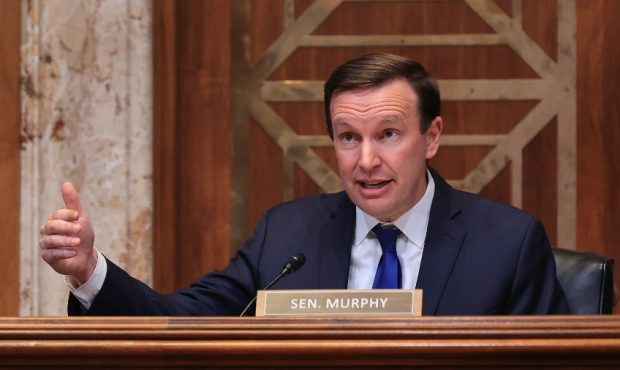
Senate Appropriations Subcommittee on Homeland Security Chairman Chris Murphy (D-CT) (L) makes opening remarks before hearing testimony from Homeland Security Secretary Alejandro Mayorkas in the Dirksen Senate Office Building on Capitol Hill on May 26, 2021 in Washington, DC. Although the Biden Administration has yet to release its FY2022 budget for the Department of Homeland Security, Mayorkas answered questions about the immigration at the U.S.-Mexico border, Coast Guard mission priorities and other topics. (Photo by Chip Somodevilla/Getty Images)
(Photo by Chip Somodevilla/Getty Images)

AP – College athletes would have the right to organize and collectively bargain with schools and conferences under a bill introduced Thursday by Democrats in the House and Senate.
RELATED STORIES

Sen. Chris Murphy (Conn.) and Sen. Bernie Sanders (Vt.) announced the College Athletes Right to Organize Act.
A companion bill was introduced in the House by Reps. Jamaal Bowman (N.Y.), Andy Levin (Mich.) and Lori Trahan (Mass.). The bill would amend the National Labor Relations Act to define college athletes who receive direct grant-in-aid from their schools as employees.
A movement at Northwestern to unionize college football players was rejected by the National Labor Relations Board in 2015.
NEWS: Today, I’m introducing legislation with @SenSanders, @RepBowman, @RepLoriTrahan and @RepAndyLevin to give college athletes the power to collectively bargain to address years of exploitation.
1/ A quick thread on what this means.https://t.co/Ypvqqs4A2a
— Chris Murphy (@ChrisMurphyCT) May 27, 2021
Murphy and Trahan are among several federal lawmakers from both parties who have previously introduced legislation related to college athletes being permitted to earn money for use of their name, image and likeness.
The NCAA has turned to Congress for help as it tries to reform its rules to allow athletes to be paid for endorsements, personal appearances and autograph signings.
Several states, including Florida, Georgia and Mississippi, have laws scheduled to take effect July 1 that would openthe NIL market to college athletes.
Congressional NIL news: Sens. Chris Murphy & Bernie Sanders are introducing the College Athlete Right to Organize Act, which provides collective bargaining rights for college athletes.
College athletes would be deemed employees and schools would be employers.
More details: pic.twitter.com/VRyVyLm60f
— Ross Dellenger (@RossDellenger) May 27, 2021
The NCAA hopes to have news rules in place by July 1 as well.
The NCAA’s proposals regarding NIL would allow athletes to enter financial arrangements with third parties. Schools would be banned from being involved in the transactions.
While the NCAA has loosened restrictions on how athletes can be compensated over the years, it has held firm to notion they are not employees.
The latest bill by Murphy, who has been one of the most vocal advocates for college athlete rights on Capitol Hill, would upend the college model.
College athletes are workers. They generate revenue. They put their body on the line.
I'm proud to lead the House version of @SenSanders and @ChrisMurphyCT's College Athlete Right to Organize Act, to amend the NLRA to provide college athletes with collective bargaining rights. https://t.co/g8kH2qTAhO
— Congressman Jamaal Bowman (@RepBowman) May 27, 2021
Scholarship athletes would be granted employee status and both public and private colleges would deemed their employers under an amended NLRA.
The NLRB would consider colleges within a conference part of a “bargaining unit.”
The bill would also protect the tax status of athletic scholarships and other benefits, and prohibit schools from asking athletes to waive the right to collectively bargain..
“Big-time college sports haven’t been ‘amateur’ for a long time, and the NCAA has long denied its players economic and bargaining rights while treating them like commodities,” Murphy said in a statement. “Having the right to do so will help athletes get the pay and protections they deserve and forces the NCAA to treat them as equals rather than second-class citizens. It’s a civil rights issue, and a matter of basic fairness.”
[ss-signup design_id=”2205276″]