Utah Football: Unloading the Notebook from Big 12 Media Days
Jul 9, 2026, 5:09 PM | Updated: Jul 10, 2026, 10:03 am

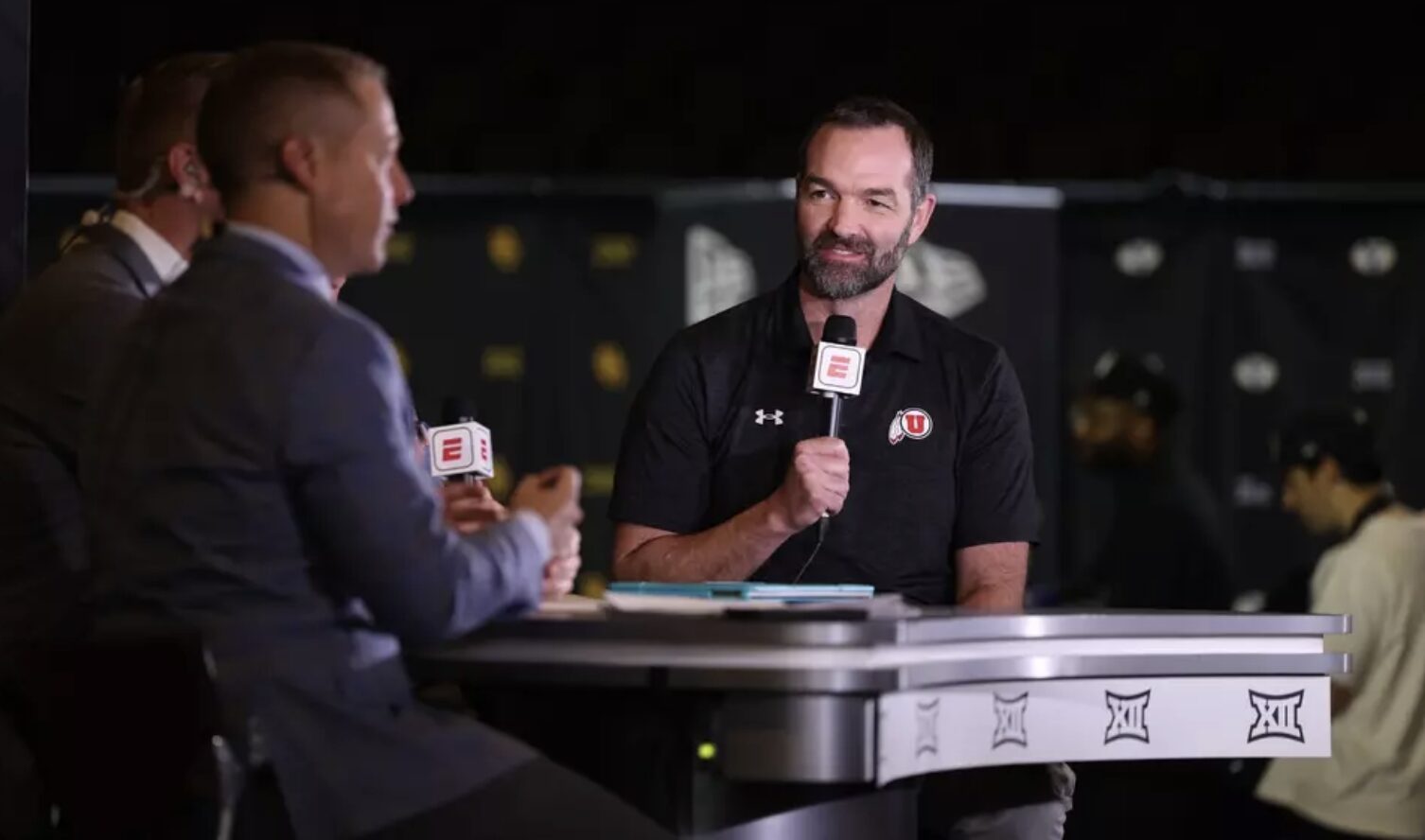
FRISCO, TEXAS - JULY 08: Head coach Morgan Scalley of the Utah Utes speaks to the media during the Big 12 Media Days at The Ford Center at The Star on July 08, 2026 in Frisco, Texas. (Photo by Stacy Revere/Getty Images)
(Photo by Stacy Revere/Getty Images)

SALT LAKE CITY — Utah football came out of Big 12 Media Days feeling like one of the conference’s most interesting teams.
The two days produced a full notebook on the Utes. Some of the notes were expected. Some were more revealing.
The Utes are not starting over. That much is clear. They are coming off an 11-win season, return one of the Big 12’s most dynamic quarterbacks, retained several key leaders and still have the structure of one of the West’s most consistent programs.
Morgan Scalley is preparing for his first full season as head coach. Kevin McGiven is taking over the offense. The offensive line is replacing NFL talent. The defense still carries Utah’s standard, but it has new personnel questions to answer.
The notebook from Frisco reflected that. There were notes on Scalley’s early fingerprints, the offensive changes, the players generating internal buzz and the reasons people around the league still view Utah as a contender despite the uncertainty.
Here are the notes, nuggets and themes that stood out.
Nationally, Utah is the Big 12’s biggest wild card
Ask enough people around Big 12 Media Days about Utah, and the answers start to sound similar. There is respect. There is curiosity. There is also a lot of wait-and-see.
Of the media members I spoke with, very few were willing to write Utah off. The program has earned too much credibility over the years for that. The culture is established. The defensive standard is real. The player development track record still matters. And even with Kyle Whittingham no longer on the sideline, there is a belief that Utah still knows what a winning football team is supposed to look like.
Most media members viewed Utah as a legitimate Big 12 title contender if the offense clicks and the line comes together. Others were more cautious, pointing to the natural growing pains that can come with a first-year head coach, a new offensive coordinator and key roster turnover.
The common thread was this: nobody was eager to dismiss the Utes.
Why Utah is still being viewed as a contender
After asking around at Big 12 Media Days, the range of opinions on Utah was wide. Some see the Utes as a legitimate title contender. Others are more cautious because of the coaching transition, offensive line turnover and new pieces on both sides of the ball.
But three reasons kept coming up for why Utah should remain in the mix.
- Utah still knows what winning looks like
The Utes are not starting over. The culture is established. The standards are real. The locker room already understands what competing looks like. That gives Morgan Scalley a better starting point than most first-year head coaches. He is not inheriting a broken program. He is taking over one that still expects to win. - The schedule sets up nicely
In a league as balanced as the Big 12, path matters. Utah’s schedule is not easy, but it is not being viewed as one of the league’s most punishing draws. Instead, sets up rather nicely. The two most difficult games, BYU & Houston, are both at home. That could matter in a race where one avoided opponent, one home-field advantage spot or one schedule break could be the difference between Arlington and the middle of the pack. - The offense may have more answers than people realize
There is curiosity about Kevin McGiven’s offense, but there is also confidence that it is being built around Devon Dampier rather than forcing Dampier to adapt to a rigid system. Utah also likes its skill talent. Scalley has praised the receiver room in unusually strong terms, and players continue to bring up Daniel Bray as a versatile weapon who could finally be fully utilized. If Dampier is comfortable, the receivers take a step and Bray becomes a real piece, Utah’s offensive ceiling may be higher than outsiders assume.
Notes around the Big 12
The schedule draw was another recurring theme. In a conference this balanced, path matters. Texas Tech avoids Utah and BYU, while Arizona State has one of the league’s rougher roads. Those differences could be the gap between Arlington and the middle of the standings.
BYU had quiet buzz, Arizona State still feels dangerous, Houston is a sleeper worth monitoring, TCU is somehow flying under the radar and Oklahoma State may be more interesting than people realize if Drew Mestemaker hits.
Baylor’s season may hinge on DJ Lagway. Kansas still believes it can keep climbing. Iowa State may be the league’s biggest mystery because of how much it has to replace.
And underneath all of it was the real theme of the week: money. NIL, revenue sharing, roster retention, jersey patches, corporate sponsorships and the Monster Energy partnership all point to the same reality.
Everyone is chasing more resources.
Scalley, Dampier made strong impressions
One other note from asking around at Big 12 Media Days: Morgan Scalley made a positive first impression.
Among the media members I spoke with, the consensus was that Scalley came across prepared, energized and comfortable in the role. There was natural curiosity about how he would handle his first full media cycle as Utah’s head coach, but the feedback was largely positive.
Devon Dampier also carried a strong reputation into the week. Most of the media members I talked with viewed Dampier as a top-three quarterback in the Big 12, and several had him as high as No. 2. That matters because Utah’s ceiling this season is tied directly to how quickly Dampier settles in as the face of the offense.
There are still questions around Utah. But Scalley’s presence and Dampier’s standing around the league are two reasons the Utes are being taken seriously.
View this post on Instagram
Scalley becoming more of an offensive CEO
One note that kept surfacing at Big 12 Media Days: Morgan Scalley is becoming more of an “offensive head coach” but in two different ways.
The first is literal. Players said Scalley is spending more time around the offense, working with Kevin McGiven and thinking through how Utah wants to attack defenses. He is not just living in his old defensive comfort zone.
The second may matter even more. Away from the field, Scalley has also been aggressive with setting up meetings for boosters, NIL conversations and the business side of modern college football.
Harlan praised how Scalley has stepped into that part of the job, and people around the program say he is not merely showing up to donor meetings because they are on his calendar. In many cases, he has planned them, or volunteered his time, helped set them up or taken the lead in getting the right people in the room.
He also described Scalley as someone who is already saying, “Let’s go see somebody,” and “Let’s go see some companies.” That is a real nugget because it shows Scalley is not just accepting the business side of the job. He is leaning into it.
That is the modern head-coaching job now, and Scalley appears to understand that.
Utah will be leaning on players to breakout
One of the more interesting things Scalley volunteered was that Utah has players on the roster who are not well known yet but could emerge this season. He compared it to previous developmental stories like John Henry Daley and Jonah Lea’ea.
That type of comment can easily sound like July coach-speak. Every coach at media days believes he has a few hidden gems.
But according to the players, there are a few guys that they were particularly excited to talk about throughout the day, and often did so on multiple times.
Daniel Bray is one of the most obvious offensive names to circle. Players continue to talk about him like someone whose role could finally match his ability in Kevin McGiven’s offense.
Byrd Ficklin also appears to have both a short-term role and a long-term path. Utah clearly values his athletic versatility now, while still viewing him as a potential quarterback answer down the road.
Karson Kaufusi, Jireh Moe, and Pupu Sepulona are names to watch along the defensive interior. The group is still young and unproven, but players around the program sound encouraged by the talent and physical development.
Daidren “Zip” Zipperer remains one of the roster’s most intriguing unknowns. The intrigue is whether he can stay healthy, settle into a role and turn internal belief into production. Creed Whittemore and Ricky Johnson were also mentioned as players pushing into the wide receiver rotation.
The bigger takeaway from that room is that Utah likes the combination of experience, urgency and voluntary extra work with Dampier.
Not all of those names will turn into major contributors. But the internal buzz is worth noting. Utah clearly believes there is more hidden production on this roster than people outside the building realize.
At his first Big 12 media days, Morgan Scalley looked and acted like someone who has been preparing for the opportunity for years.https://t.co/HYC0kFMj5M
— Josh Furlong (@Josh_Furlong) July 9, 2026
Texas Tech: Villains
One unavoidable Big 12 Media Days note: Texas Tech has fully embraced the villain role.
The Red Raiders were again one of the loudest storylines in the room. Brendan Sorsby. The spending. The confidence coming out of Lubbock. The sense that plenty of people around the league are already tired of hearing about them.
All of it has turned Tech into one of the Big 12’s most polarizing teams.
The media piece of this is hard to ignore. Some reporters did not exactly hide their affection for Lubbock or their willingness to lean into the Texas Tech storyline. A little personality is fine. That is part of the job now. But there is a line between acknowledging a team’s edge and openly feeding the narrative because you enjoy the bit.
Still, Texas Tech does not seem bothered by any of it. If anything, the Red Raiders appear to like it. Joey McGuire took photos with Sean Dillon, the now infamous Brett Yormark questioner. Players reportedly acknowledged that people rooted against them last season and will probably do the same again this year.
They seem fine with that. Most programs try to manufacture an “us against the world” mentality. Texas Tech does not really have to. The money, the scrutiny, the outside irritation, the media attention — it is already built in.
Takeaways from Mark Harlan’s availability
Utah’s AD met with media and interview with multiple radio stations, here are the takeaways from his comments.
- Scalley is trying to make Utah feel more connected as a full team.
Harlan noted that Utah has had a bit of an offense-defense split over the years. One of the things he has enjoyed watching is Scalley’s leadership training and the way the team appears to be coming together more as one complete group. That lines up with the broader “offensive CEO” theme. This was also a point made by other sources around the program, who highlighted how Scalley is much more engaged with the players. - Crimson Brand Partners is moving fast.
Harlan said Crimson Brand Partners is up and running, moved into a new building up near Research Park, with plans of hiring people that could reach 70 employees before the football season. That is a major operational shift, and it gives Utah more infrastructure around revenue, NIL, fan experience and corporate partnerships. - The private equity/Crimson Brand Partners money is about generating more money.
Harlan framed the deal as “operating cash to generate cash.” That is the simple version of Utah’s strategy: use new operational resources to grow annual revenue, improve fan experience and create more NIL opportunities. Harlan even mention Ryan Smith and the Jazz operation as the model they are trying to follow with the commercial operations. - Utah expects athletes to show up in more campus-wide NIL deals.
Harlan said fans should start seeing more Utah athletes involved in all-campus deals, not just traditional athletics sponsorships. That is one of the more tangible ways Crimson Brand Partners could affect football, basketball and Olympic sports. - adidas rose above the competition because of NIL, made Utah priority
Harlan said Adidas stood out largely because of its all-student-athlete NIL approach. He stressed that it is not just for the biggest names, and that feedback from places like Arizona State and Kansas showed the model was real, not just a sales pitch. Harlan noted that Adidas’ president came to campus, toured the bookstore and spent real time understanding Utah’s brand. That is a good detail because apparel deals are not just about logos and uniforms anymore. They are about activation, NIL, retail and department-wide alignment. - Harlan sees adidas as a significant basketball boost.
One understated tidbit, which gains significance since this was football media day: Harlan specifically mentioned adidas’ strength in the basketball space and said he believes what Adidas is doing in college basketball can help Utah “in a lot of different ways.” That is a useful detail with Alex Jensen trying to build momentum in a brutally competitive Big 12. And the benefit to the basketball program was a significant reason for choosing adidas. - Harlan has come around on a 24-team playoff.
Harlan said he has “come around to 24” teams for the College Football Playoff after serving on the selection committee and seeing quality teams miss out. His argument is that a larger field would allow schools to schedule more aggressively without being punished as harshly for one loss. - The Huntsman Center’s bones are stronger than expected.
Harlan said early engineering work showed the Huntsman Center is “incredibly sturdy” and even stronger than they thought. That reinforces the idea that Utah may have a real opportunity to renovate and reimagine the inside rather than start from scratch. - The Huntsman renovation is center to College Town Magic.
Harlan made it clear that the arena project is part of a bigger vision around College Town Magic. The Huntsman is not just being treated as a basketball and gymnastics venue. Utah views it as a potential anchor for retail, campus energy and a more complete fan experience. - Rice-Eccles upgrades are coming in layers.
Harlan mentioned red lights, possible north end zone field-level suites or box seating, and a new game experience coordinator with professional experience. The clear message: Utah knows the stadium environment is already strong, but also knows it needs to keep improving the details.
The Bottom Line
Morgan Scalley is putting his own stamp on the program. Kevin McGiven is reshaping the offense around Devon Dampier. The offensive line has something to prove. The defensive front has young players who need to grow up quickly. And several potential breakout pieces still have to turn internal buzz into actual production.
The Utes are still Utah. The culture is established, the defensive standard remains, the locker room has veteran leadership and the program is not starting from scratch just because Kyle Whittingham is no longer leading it.
That is what makes this team so difficult to project. Utah has enough continuity to contend, enough change to create real questions and enough talent to make the rest of the Big 12 uncomfortable.
The Utes may not be the safest pick in the conference. But they might be the team nobody wants to deal with if the new pieces click.