After year one reset, Alex Jensen begins building Utah’s foundation
Apr 29, 2026, 2:12 PM | Updated: Apr 30, 2026, 10:14 am

Alex Jensen instructing at practice. Photo credit to Utah Athletics.

SALT LAKE CITY — For Alex Jensen, the job hasn’t slowed down — it’s just become more manageable.
A year into leading the Utah Runnin’ Utes men’s basketball, Jensen sounds like a coach who understands the chaos now. And in today’s version of college basketball, that might be the job.
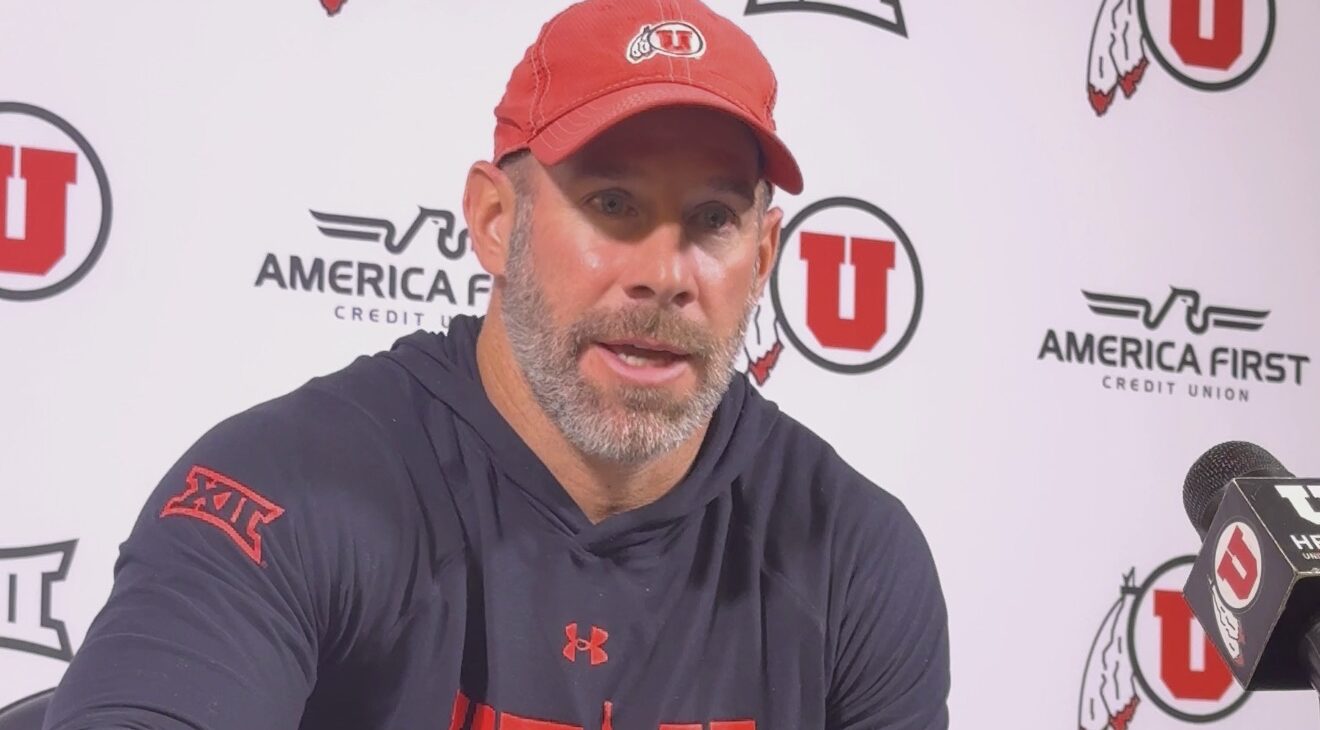
Jensen joined Scotty G. & The Coach to talk about the offseason and how much better equipped he and his staff are compared to last year.
A year of clarity in a chaotic system
When Jensen first took over, he was juggling two worlds — finishing responsibilities in Dallas while trying to build a college roster largely over Zoom. Now, there’s at least a framework — and more importantly, time behind it.
“It’s still a fire hose,” Jensen said, “but we felt much more confident this year… we had a good process going into it.”
That confidence didn’t come from slowing the portal down — it came from finally being able to prepare for it. A year ago, Utah was reacting in real-time.
With a full cycle to evaluate the landscape, Jensen and his staff were able to study rosters across conferences, identify realistic portal targets, and get a clearer sense of positional value and pricing before the window even opened.
That matters in a market where timing is everything. The transfer portal still moves fast — sometimes within 24 to 48 hours — forcing staffs to evaluate not just talent, but character, fit, and intent almost instantly.
That’s the part Jensen doesn’t gloss over.
“It’s mind-blowing,” he said. “You do it through a Zoom and it can move as fast as a day or two.”
The difference now is Utah isn’t scrambling to figure it out in real time.
Instead, it had structure — background work done months in advance, clearly defined traits they value, and a front office-style approach led by general manager Wes Wilcox.
Why “wanting to be here” matters more than ever
In a landscape driven by money and movement, Jensen keeps coming back to something old-school: buy-in.
“We’ve got a lot of European connections on our staff, but you have to be careful with those guys — really, with any guys,” he shared. “At the end of the day, they’ve got to want to be here.”
That applies across the board, but especially with Utah’s growing international footprint. Jensen acknowledged the appeal of European players — often more experienced and physically prepared — but also noted the adjustment curve.
The Utes added international pieces like Noam Yaacov and Alec Anigbata. With those two in particular, both Jensen & Wilcox traveled overseas to visit with each of them. Developing relationships with them to create that sort of buy-in.
“There’s money involved, there’s a lot that goes into it, but coming to the University of Utah has to mean something,” Jensen stated.
While that used to be commonplace in recruiting, as the game has evolved around NIL, that sort of effort has fallen off. But for Jensen and the Runnin’ Utes, it was a key factor in landing those two targets.
“I’m excited about the group we’ve brought in, especially the European players, but it is a transition,” Jensen said.
Alongside them, portal contributors such as Jackson Holcombe, Taison Chatman, and TJ Burch to reshape the perimeter. Utah has also added the 2026 class — Styles Clemmons, Simeon Suguturaga, and David Katoa — and added frontcourt pieces like Zati Loubaki, Jaxon Johnson, and Fynn Schott to round out the roster.
“College basketball is a different game, and if you look at the analytics, it usually takes about a year for those guys to fully adjust,” he shared. “The good thing for us is we’ve got the summer, so hopefully we can speed that process up.”
The reality of modern college basketball
Transitioning from his team to the bigger picture, Jensen didn’t dodge the questions. College basketball, in his words, is “in such a transition state,” and not always in ways that make sense.
That uncertainty is only increasing with sweeping changes seemingly on the horizon. The NCAA is pushing toward a “5-for-5” eligibility model — a system that would allow players to compete for five full seasons within a defined five-year window, eliminating redshirts and simplifying a rulebook that’s been stretched thin by waivers and exceptions.
At the same time, conversations around stricter transfer portal guardrails — including limits on movement and clearer enforcement around tampering — are gaining momentum, while NIL remains largely unregulated in practice, creating a marketplace that shifts faster than policy can keep up.
Put it together, and the result is a system that’s evolving in real time, often without full alignment between rules, enforcement, and reality.
That’s where Jensen’s frustration lives.
“I think college sports could really use a couple, easy guardrails,” he said. “Since I’ve taken the job, all I’ve heard about is all this stuff that’s going to happen, but I won’t believe anything I hear until it’s signed.”
Instead, coaches are left managing rosters with moving targets — balancing eligibility questions, portal timing, and NIL expectations, all while trying to build something sustainable. And that’s before you even get to the basketball.
The Bottom Line
This is what year two is supposed to look like — not polished, not finished, but intentional.
Alex Jensen has maintained a long-term vision over selling a quick turnaround. He’s building a foundation using structure, evaluation, and buy-in to stabilize something that’s been volatile for years.
On paper, Utah is better positioned now — not because the chaos has gone away, but because Jensen and staff have had time to adapt to how to operate within it. The roster construction has greater rhyme and reason to it than last year’s offseason overhaul. That’s the shift.
And if that approach holds — if the right players are in place for the right reasons — the rebuild stops being theoretical and starts showing up where it matters most: in wins, and eventually, in a full Huntsman Center again.