Utah DE Lance Holtzclaw brings student-athlete voice to Capitol Hill
Jun 3, 2026, 12:04 PM | Updated: 4:13 pm

University of Utah's Lance Holtzclaw testifies before Senate Committee on Commerce, Science, and Transportation hearing to examine college sports, supporting student athletes, and fair competition on Capitol Hill, Wednesday, June 3, 2026, in Washington. (AP Photo/Jose Luis Magana)
(AP Photo/Jose Luis Magana)

SALT LAKE CITY — Utah defensive end Lance Holtzclaw was not in Washington, D.C., on Wednesday to speak as a conference commissioner, athletic director or former national championship-winning coach.
He was there as something just as important in the current college sports debate: a current student-athlete living through the system in real time.
Holtzclaw testified before the Senate Commerce, Science and Transportation Committee during Wednesday’s hearing on the Protect College Sports Act of 2026, a bipartisan bill introduced by Sens. Ted Cruz, Maria Cantwell, Eric Schmitt and Chris Coons.
The hearing, titled “Protecting College Sports: Supporting Student Athletes, Restoring Fair Competition, and Saving the Games Fans Love,” included a high-profile witness list featuring former Alabama coach Nick Saban, Notre Dame athletic director Pete Bevacqua, former West Virginia president Gordon Gee and Pac-12 commissioner Teresa Gould.
Holtzclaw gave Utah a direct voice in one of the most significant college athletics conversations taking place in Washington.
Lance Holtzclaw’s testimony
In his written testimony, Holtzclaw thanked the committee for including student-athletes in the conversation and framed his appearance around the perspective of someone who has personally experienced many of the sport’s recent changes.
“My name is Lance Holtzclaw, and I am a football student-athlete at the University of Utah,” Holtzclaw said. “It is an honor to be here representing current and future student-athletes across the country.”
Holtzclaw’s path gives him a unique view of the modern landscape. He was recruited during the COVID-19 pandemic, began his college career at Washington, competed during the final years of the Pac-12, played on a team that reached the College Football Playoff National Championship Game, then transferred to Utah as the sport continued to shift around NIL, the portal and conference realignment.
Utah DE Lance Holtzclaw does not take a position on the bill in his submitted witness testimony. pic.twitter.com/X26tGy1Y0B
— Ross Dellenger (@RossDellenger) June 3, 2026
That experience became central to his testimony.
Holtzclaw said he has seen the impact of NIL, the transfer portal, conference realignment, eligibility rules and the larger uncertainty now shaping college athletics. His message was not that athletes should be excluded from reform, but that they must be included in shaping it.
“Decisions about college athletics should not be made solely for student-athletes but made with student-athletes,” Holtzclaw said.
Why his voice matters
Holtzclaw is not the most famous name attached to Wednesday’s hearing, and that is part of what made his testimony notable.
He is not a Heisman Trophy candidate or a projected first-round pick. He is a Power Four football player who has had to navigate the realities that most college athletes face: recruiting disruption, roster movement, conference instability, academic responsibility, NIL opportunities and the uncertainty of what comes next.
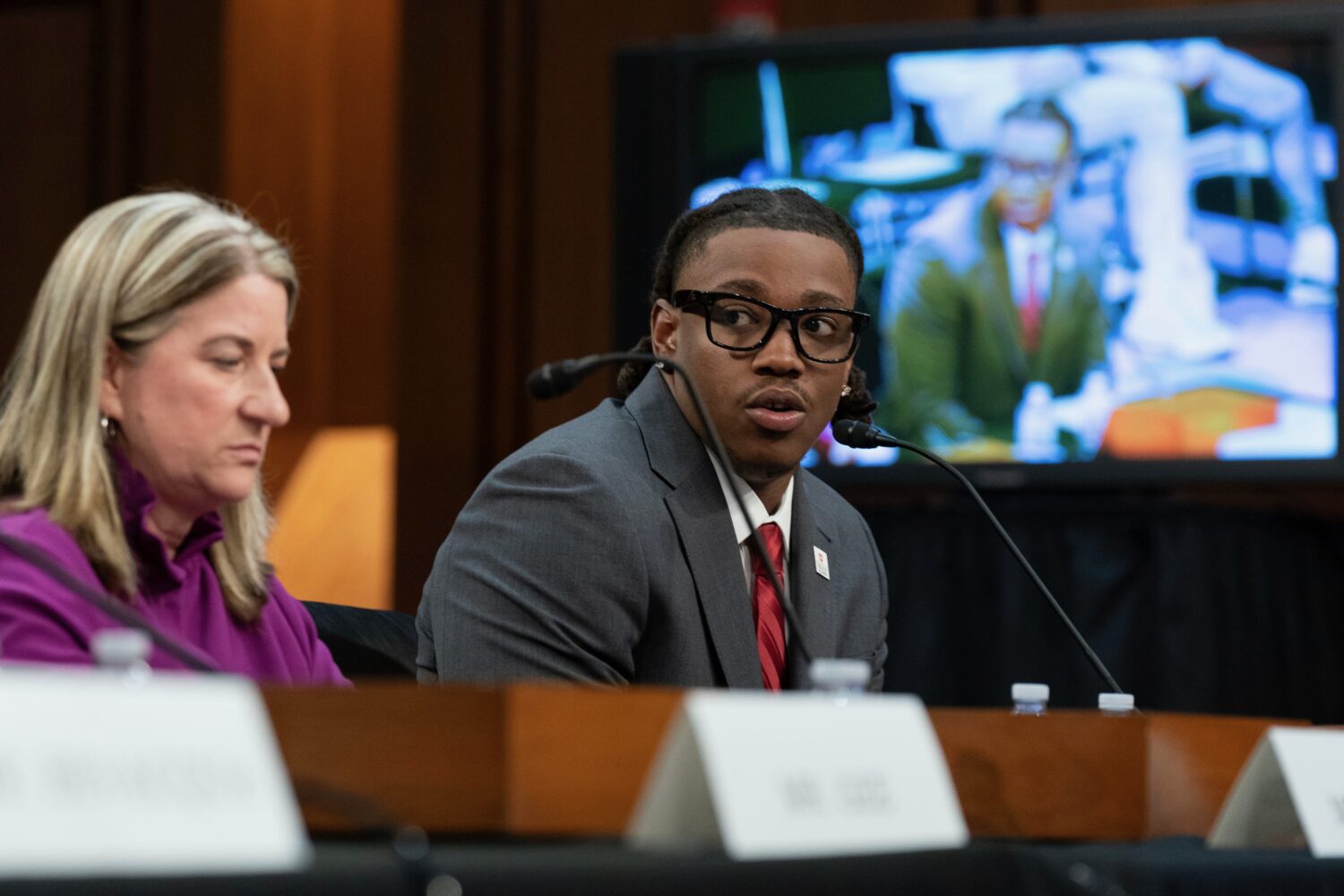
University of Utah’s Lance Holtzclaw testifies before Senate Committee on Commerce, Science, and Transportation hearing to examine college sports, supporting student athletes, and fair competition on Capitol Hill, Wednesday, June 3, 2026, in Washington. (AP Photo/Jose Luis Magana)
That matters because many of the loudest voices in the national conversation are coming from administrators, coaches, lawmakers, television partners and conference executives. Holtzclaw’s testimony brought the discussion back to the locker room.
For Utah, it also reflected the program’s growing role in the broader college sports conversation. The Utes are no longer just a successful regional football program trying to keep pace. They are a Big 12 program operating in the middle of the sport’s changing power structure, with athletes whose experiences stretch across the Pac-12, Big Ten and Big 12.
Holtzclaw has lived that transition directly.
After spending three seasons at Washington, he transferred to Utah and became part of the Utes’ defensive front in 2025. He played in all 13 games, totaled 26 tackles, four tackles for loss, 1.5 sacks and three pass breakups, and started Utah’s Las Vegas Bowl win over Nebraska.
He also earned his degree in sociology at Utah and still has one season of eligibility remaining.
What the Protect College Sports Act would do
The Protect College Sports Act is designed to create a national framework for college athletics at a time when leaders across the sport have argued that state-by-state NIL laws, transfer disputes, eligibility lawsuits and revenue-sharing questions have created instability.
According to the Senate Commerce Committee’s summary, the bill would establish national rules around NIL, transfers, eligibility, recruiting, tampering, athlete-agent conduct, academic protections and medical coverage.
Among its key provisions, the bill would preserve athletes’ ability to earn NIL compensation, require NIL disclosures above certain thresholds, create agent rules and fee limits, establish transfer and eligibility standards, protect scholarships from being reduced or revoked because of injury or performance, require medical coverage for sports-related injuries, and create an independent student-athlete ombudsman.
The bill also includes broader structural pieces, including provisions tied to media rights, rivalry preservation, women’s and Olympic sports, and limits on further consolidation among major conferences.
In simple terms, Congress is being asked to decide whether college sports needs a national rulebook — and what protections should come with it.
A player who has seen the chaos firsthand
Holtzclaw’s testimony landed because his career has touched nearly every major issue now being debated.
He was recruited during a pandemic, when visits were limited and evaluations were disrupted. He played at Washington during the program’s run to the national title game and during the final season of the Pac-12 as it had long been known. He transferred to Utah as conference realignment continued to reshape schedules, travel and roster construction.
Utah DE Lance Holtzclaw with a very thoughtful answer on his working relationships with agents in college athletics.
He notes the good experiences, and bad
“I’ve had great experiences when it comes to me and an agent. I’ve also seen the bad side with teammates I’ve had..” pic.twitter.com/DvdkJM5efJ
— Trey Wallace (@TreyWallace) June 3, 2026
He has also experienced the new player-movement era from the athlete side, where opportunity and instability often exist at the same time.
That is the tension at the heart of the national debate.
Athletes have more freedom and more earning potential than ever before. But the system around them remains unsettled. Schools are trying to manage revenue sharing, NIL collectives, transfer windows, roster limits, legal exposure and competitive balance all at once.
Holtzclaw’s testimony did not attempt to solve every issue. Instead, it emphasized that whatever comes next should keep the student-athlete experience at the center.
“College athletics has provided me with incredible opportunities, relationships, and experiences that have helped elevate my life in tremendous ways,” Holtzclaw said. “I believe strongly in preserving those opportunities for future generations while continuing to improve a system that serves the student-athletes at its center.”
The Bottom Line
Wednesday’s hearing comes at a critical point for college sports. Utah’s Lance Holtzclaw’s testimony gave student athletes a seat in one of the most important conversations in college athletics.
The Protect College Sports Act may change, stall or face significant resistance before becoming law. But the message from Holtzclaw was clear: college sports reform cannot just be about schools, conferences, coaches, television money or legal protection.
The House settlement has already pushed schools into a new era of direct revenue sharing. NIL remains difficult to regulate. Transfer movement has changed how coaches build rosters. Conference realignment has widened the gap between the wealthiest leagues and everyone else. At the same time, the Big Ten and SEC have raised concerns with the Protect College Sports Act as currently drafted, particularly around unresolved legal issues, state-law preemption and media-rights provisions.
That pushback is significant, because any federal solution will need to survive not only political debate but resistance from the most powerful conferences in the sport.
However, should college sports be all that concerned with the two conferences primarily responsible for creating this mess?
It has to include the athletes. And on Wednesday, atheUtah defensive end stepped up to make sure that voice was heard.