Devon Dampier’s progression reveals what could come next for Utah in 2026
Aug 27, 2026, 5:39 PM | Updated: 5:40 pm

SALT LAKE CITY — Devon Dampier proved to be a considerably better quarterback last season, despite throwing for fewer yards than he did during his final season at New Mexico.
His 2024 season established him as one of college football’s most electric playmakers. But also one with questions regarding his ‘quarterbacking’ ability.
His 2025 season proved he could operate as a more efficient, protector of the football, while executing against more talented Big 12 defenses.
In 2026, he needs to find a balance between the electric playmaker in ‘24 and the efficient decision-maker in ‘25.
From carrying an offense to operating one
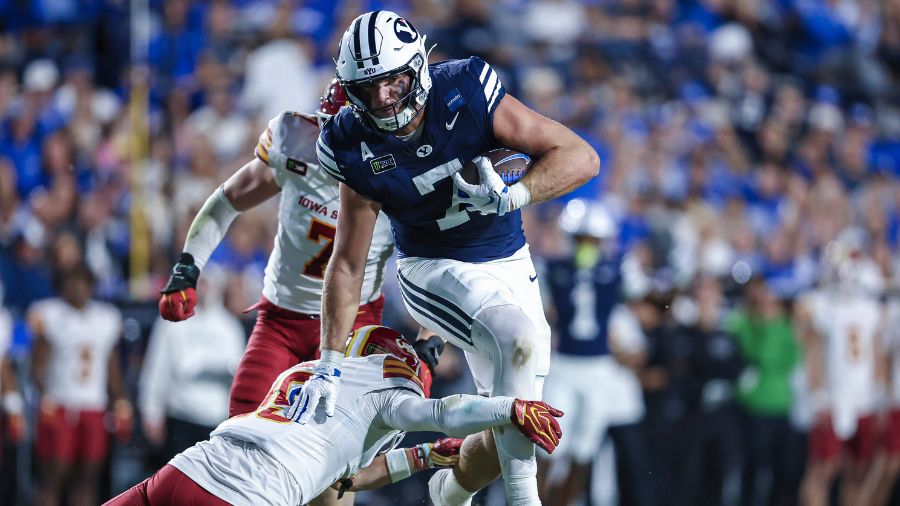
At New Mexico, Dampier was relied on to create nearly everything. The end result was an impressive 3,934 yards of total offense and 31 touchdowns, first-team All-Mountain West honors and the first 1,000-yard rushing season by a quarterback in program history.
Dampier completed 226 of 390 passes for 2,768 yards, 12 touchdowns and 12 interceptions while adding 1,166 yards and 19 touchdowns on the ground.
It was the sort of dynamic individual effort that gives the college football sickos late-night appointment viewing television.
Fast forward a bit, Dampier followed his offensive coordinator, Jason Beck, to Salt Lake City. Utah offered an elite offensive line, a deeper collection of skill talent, and a second season in the same offensive system.
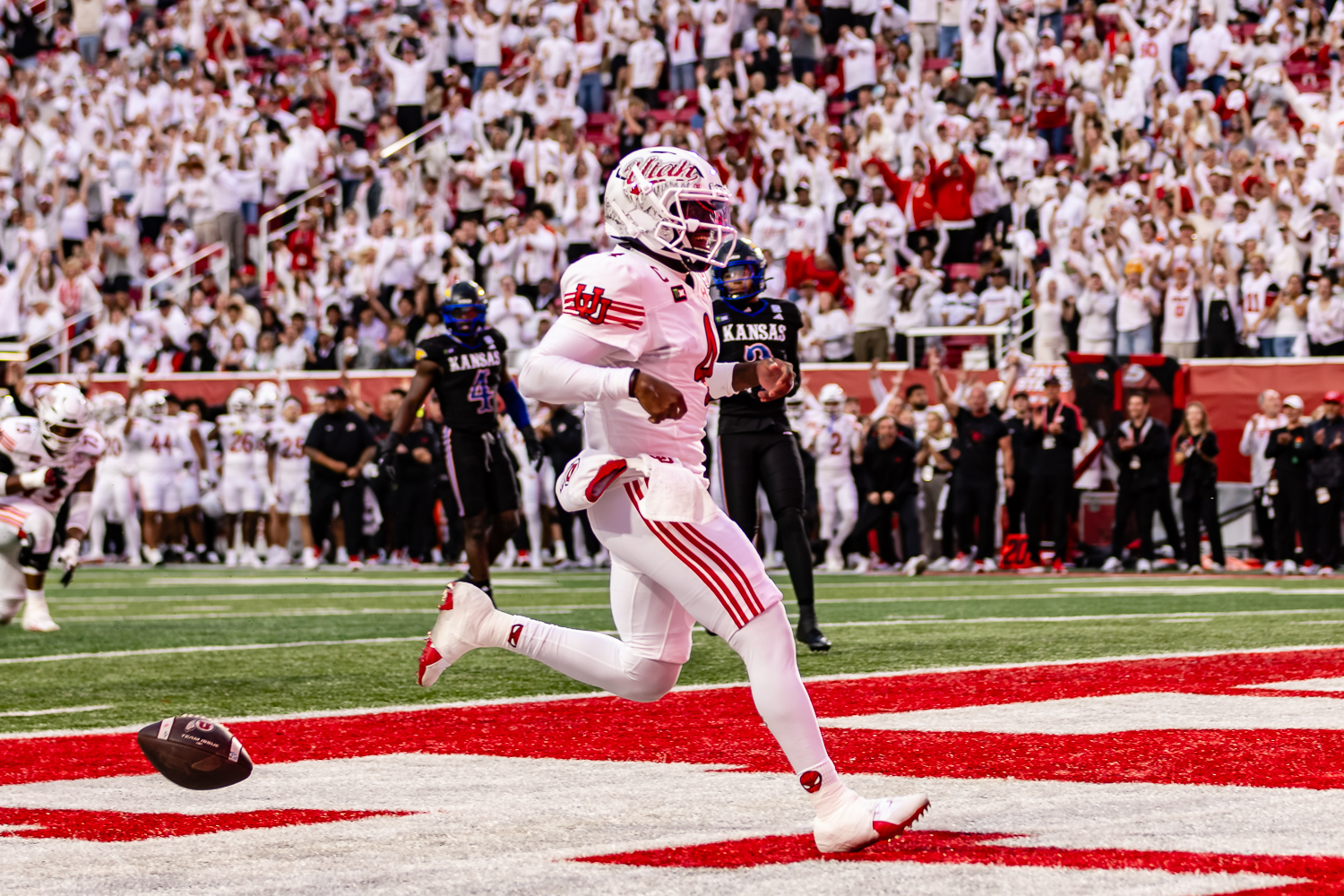
Dampier’s total offense declined to 3,325 yards, but touchdown creation, ball security and situational performance improved.
| Category | 2024 at New Mexico | 2025 at Utah | Change |
|---|---|---|---|
| Completion percentage | 57.9% | 63.5% | +5.6 percentage points |
| Passing yards | 2,768 | 2,490 | -278 |
| Yards per attempt | 7.1 | 7.5 | +0.4 |
| Passing touchdowns | 12 | 24 | +12 |
| Interceptions | 12 | 5 | -7 |
| Passer rating | 121.6 | 146.8 | +25.2 |
| Rushing yards | 1,166 | 835 | -331 |
| Rushing touchdowns | 19 | 10 | -9 |
| Total touchdowns | 31 | 34 | +3 |
His touchdown rate more than doubled, his interception rate fell by approximately half and his ESPN Total QBR rose from 71.2 to 84.4, seventh nationally. He attempted 56 fewer passes and rushed for 331 fewer yards, yet accounted for three more touchdowns.
That is progression, especially given the increased competition level.
Where Dampier made his biggest leap
The most encouraging development may have occurred in situational football.
Dampier completed 45 of 77 third-down attempts for 708 yards, 10 touchdowns and two interceptions, producing a 173.4 passer rating.
| Passing situation | 2024 at New Mexico | 2025 at Utah |
|---|---|---|
| Third-down completion percentage | 42.0% | 58.4% |
| Third-down TD-INT | 3-2 | 10-2 |
| Third-down passer rating | 103.6 | 173.4 |
| Second-half completion percentage | 56.4% | 64.7% |
| Second-half TD-INT | 3-7 | 13-3 |
| Second-half passer rating | 110.3 | 157.9 |
| Fourth-quarter completion percentage | 52.7% | 64.0% |
| Fourth-quarter TD-INT | 3-3 | 8-2 |
| Fourth-quarter passer rating | 103.2 | 182.9 |
From his ‘24 campaign, the improvement in Dampier’s functional accuracy, decision-making and situational execution was substantial.
Yet, there’s still plenty of room for further development in all areas, but Dampier was solid in key situations.
The accuracy improvement was real — and specific
Utilizing tools from Pro Football Focus and HudlIQ: Dampier became more consistent on short throws and maintained a very solid standard in the intermediate, but did not become uniformly more accurate.
Adjusted completion percentage helps separate the quarterback’s accuracy from drops and attempts that were not realistically intended to be completed.
| Passing depth | 2024 adjusted completion | 2025 adjusted completion | 2024 PFF passing grade | 2025 PFF passing grade |
|---|---|---|---|---|
| Behind line of scrimmage | 87.5% | 100.0% | 67.3 | 72.0 |
| Short, 0–9 yards | 78.9% | 83.9% | 65.2 | 72.8 |
| Intermediate, 10–19 yards | 61.0% | 57.3% | 85.3 | 90.4 |
| Deep, 20-plus yards | 39.4% | 31.5% | 82.8 | 67.1 |
More efficient without becoming conservative
The most obvious area of improvement came for Dampier were passes within 10 yards. His adjusted completion rate on short throws rose from 78.9% to 83.9%, while his grade climbed from 65.2 to 72.8, meaning he honed in his short throw accuracy.
Even though his average depth of target fell from 11.9 yards in 2024, Dampier’s 10.6-yard average depth of target still tied for the Big 12 lead last season. And another encouraging number, his 2.8% turnover-worthy-play rate was sixth lowest in the conference.
Dampier did not cut his interceptions from 12 to five by becoming a checkdown passer. He knew where to go with the ball, eliminated some poor decisions, and leaned on more reliable, repeatable throws.
The intermediate story requires more nuance
Moving into the next area of the passing attack, Dampier’s adjusted completion rate between 10 and 19 yards actually declined from 61% to 57.3%. However, his PFF grade improved from 85.3 to 90.4, and touchdowns increased from five to 12, while interceptions dropped from three to one. All in all, Dampier produced 723 yards on 42 of 82 attempts to the intermediate areas of the passing game.
He was not completing everything, or even complete a higher rate of passes. He was producing more high-value throws and fewer damaging mistakes in the areas Utah emphasized, hence the increased grade.
The deep ball became more dangerous, now it needs to become more dependable
Dampier’s raw vertical production improved, but there are reasons it’s not as simple to say he became a better vertical passer.
To start, his touchdowns improved from just one thrown in ‘24 to six, while his “big-time throws” jumped from nine to 16 this season. However, the adjusted completion rate fell from 39.4% to 31.5%, and the PFF deep grade declined from 82.8 to 67.1.
There was explosiveness, but clearly a lot of volatility, and the biggest culprit behind that designation was repeatability, or consistent decision making.
Dampier produced more high-end vertical throws, but the spectacular completions were surrounded by too many misses and turnover-worthy plays.
Still, the season arc remains encouraging. Dampier began 1-of-14 on deep attempts before completing 16 of his final 40, including an outstanding performance in the Las Vegas Bowl.
And one last element to consider is the improved talent at the receiver positions this season. Utah brought in two consistent vertical threats in Braden Pegan and Kyri Shoels, both should help Dampier’s cause in raising his consistency down the field.
What Utah is asking from him now
Kevin McGiven’s offense will preserve Dampier’s designed rushing, RPO and movement value. Turning him into a stationary pocket passer would be an excellent way for Utah to outsmart itself.
But McGiven and quarterbacks coach Ryan Gunderson have also emphasized processing: recognizing defensive structure, understanding protection answers, eliminating unavailable routes and knowing when to work a full-field progression.
Gunderson described the objective as learning to “play slow pre-snap” to play fast afterward. Dampier is capable of overcoming mishaps post-snap, but his next evolution is becoming more cerebral pre-snap.
There is a lot of talent around him at the skill positions. Dampier will have options to get Utah in favorable situations far more often than not. He also has a responsibility to balance the attack and spread the wealth around.
What a 2026 breakthrough could look like
While he’s clearly capable of hitting the mark, Dampier does not need 4,000 yards of total offense to improve. A modest progression would place him around to 2,700-2,900 passing yards, 25-27 touchdowns and six to eight interceptions, with another 700 yards and multiple touchdowns on the ground.
More specifically, Dampier has to maintain the improved efficiency he showed last season in the short passing game. He has to maintain the completion rates and grades, if not even improve at least a little, in the intermediate areas of the field. Lastly, Dampier has to improve as a passer deep down the field.
The rebuilt offensive line lowers the floor from last season, but Utah’s deeper, bigger receiving corps gives him better answers against loaded boxes, and Ficklin can absorb some designed runs.
That makes this season an appropriate test of how far his quarterbacking has actually developed.
In 2024, Dampier was the entire New Mexico offense, good and bad. In 2025, he learned how to efficiently operate and rely on those around him.
Now, as the Utes head into a new era under Morgan Scalley, they need the complete version—the creator and the commander—to take ownership of this team and lead it where it believes it belongs.