Pitch Clocks, Shift Limits, Larger Bases In MLB’s Future
Jul 18, 2022, 12:34 PM
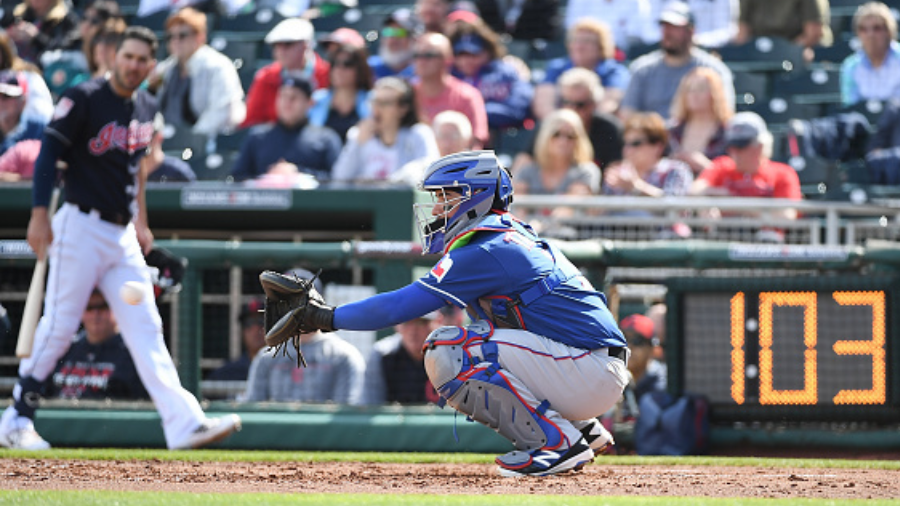
GOODYEAR, AZ - FEBRUARY 25: Jose Trevino #71 of the Texas Rangers catches a warm up pitch as the pitch clock ticks down during the third inning of a spring training game against the Cleveland Indians at Goodyear Ballpark on February 25, 2019 in Goodyear, Arizona.

LOS ANGELES (AP) — Justin Verlander, Gerrit Cole and the rest of major league pitchers are likely to be looking over their shoulders next season — at a pitch clock.
Clocks have cut the length of minor league games by about a half-hour this year, and baseball officials appear certain to promote the timers to the majors.
“I think it needs it, obviously. And I think it’s coming regardless of opposition of the players. It’s kind of our fault,” the Yankees’ Cole said ahead of Tuesday’s All-Star Game. “We’ve known it’s been an issue and its importance and we don’t seem to clean it up.”
Major League Baseball also is considering shift limits, larger bases, restrictions on pickoff attempts and — perhaps in 2024 — limited use of robot umpires to call balls and strikes. The new collective bargaining agreement includes an 11-person competition committee with six management representatives, four players and one umpire, and it is empowered to make changes by majority vote with 45 days’ notice.
For further context, Minor League Baseball is using limits of 14 seconds between pitches with the bases empty and 18 seconds between pitches with runners on base in 2022. In the first days after this timing was instituted in April, the average time of game was 2:39.
— Glenn Geffner (@GlennGeffner) May 26, 2022
Average time of nine-inning games increased from 2 hours, 43 minutes in 2003 to 3:13 in 2020 before dropping to 3:02 so far this season through July 12, according to the Elias Sports Bureau. A clock experiment in the minor leagues cut the average this year to 2:37 from 3:04 at a similar point for non-clock games last year.
“At first, I wasn’t buying into it. But then we started the season, I was, ‘Oh, this is pretty good.’ I like it. I think it’s more efficient,” Brooklyn Cyclones manager Luis Rivera said before a 9-0 win over Greensboro on July 12 that breezed along in 2:27.
Time between pitches with no runners on base ranges from 12.6 seconds for Milwaukee’s Brent Suter and San Francisco’s Sam Long to 26.6 for St. Louis’ Giovanny Gallegos and 26.0 for Atlanta’s Kenley Jansen. With runners on, San Diego’s Tim Hill leads at 18.1 and Gallegos (32.1) and Jansen (31.1) are the slowest.
MLB’s average through Thursday was 20.5 seconds with no runners and 27.3 second with runners. Boston manager Alex Cora notices call-ups are working more quickly than veterans.
“Little by little, everything they’re doing in the minor leagues is going to affect their big league game, which is great,” he said.
Long the most traditional of U.S. major pro sports, baseball adopted video review for home runs in 2009 and for a broad array of umpire decisions in 2014. All 30 teams are using the electronic pitching signaling device introduced this spring.
A clock is being used this year throughout the minors: 14 seconds with the bases empty and 19 with runners on at Triple-A, and 14/18 at lower levels. The clock starts “when the pitcher has possession of the ball and the catcher is in the dirt circle surrounding home plate.” In addition, “the batter must be in the box and alert to the pitcher with at least nine seconds remaining.”
A pitch clock is likely coming to MLB in 2023. Some Reds players who had it in the minors aren’t fans.
“Overall, it puts a lot of pressure on you because you have that clock against you.” https://t.co/Yfphg4ngLu
— Bobby Nightengale (@nightengalejr) July 17, 2022
“I’m not opposed to a pitch clock, but I think it needs to be a reasonable amount of time to not feel rushed,” said Houston’s Verlander, a two-time Cy Young Award winner. “Fourteen is quick. I was kind of like on the fence about it, maybe pro pitch clock, but then talking to a couple of the Triple-A guys we’ve had, they feel in certain situations that they don’t even have enough time to shake off pitches. Granted, they don’t have PitchCom down there.”
Yankees pitcher Ryan Weber, who spent the first two months this season in the minors, favors a clock but with four additional seconds. He pointed to a 3-2 fastball he threw to Norwich’s Patrick Dorrian on April 17 that ended a nine-pitch at-bat with a flyout. He feared a violation that would cause ball four.
“If I throw a pitch, catch the ball and then go around to the rosin bag, and then when I get on the mound and I’m looking for the sign, it’s running low and I got to say yes to that pitch,” Weber recalled. “I just grooved it. I felt that I was forced to throw.”
Violations dropped from 1.73 per game during the opening week to 0.52 in Week 11.
MLB’s goal is to eliminate dead time, such time-consuming tics such as Nomar Garciaparra tapping toes and adjusting batting gloves between pitches.
“It’s something that takes a while to get used to, but I think overall the impact it had on the pace of the game was good,” said the Yankees’ Matt Carpenter, who spent April at Triple-A with Round Rock.
Minor league pitchers also have been limited to what the regulations call “two disengagements per plate appearance” with runners on — pickoff attempts or stepping off the runner. A third attempt that is unsuccessful results in an automatic balk.
Bases have been increased to 18-inch squares from 15, promoting safety — first basemen are less likely to get stepped on — but also boosting stolen bases and offense with a slightly decreased distance.
Look: New MLB base sizes are remarkably biggerhttps://t.co/6EiIhbrfQa via @AudacySports pic.twitter.com/3n0G4IfTDn
— 670 The Score (@670TheScore) March 9, 2022
Shifts have been limited all season at Double-A and Class A, where teams are required to have four players on the infield, including two on each side of second base. The Florida State League adds an additional restriction starting July 22 by drawing chalk lines in a pie shape from second base to the outfield grass, prohibiting infielders from the marked area pre-pitch.
Use of shifts has exploded in the past decade, from 2,357 times on balls hit in play in 2011 to 28,130 in 2016 and 59,063 last year, according to Sports Info Solutions. Shifts are on pace for 71,000 this year.
There has been a corresponding drop in the big league batting average from .269 in 2006 to .255 in 2011 to .242 this season, on track to be the lowest since 1967 — before the mound height was cut.
“I like organic primarily,” said former Rays, Cubs and Angels manager Joe Maddon. “If we have to legislate our game to become better, I would put the all the infielders on the dirt, but I’d still permit three on the one side.”
Shift ban tests are hard to interpret, given there is far less shifting and defensive data in the minors.
MLB also is piloting an Automated Ball-Strike System in the minors, which could reach the majors as soon as 2024. Defining the computer strike zone is still being worked on.
Big league umps are much criticized in an age of high-speed video cameras analyzing every pitch.
Jeremie Rehak and Pat Hoberg have been the most accurate plate umpires this season at 95.6% correct, according to UmpireScorecards.com. Among umps who have worked more than one game calling balls and strikes, Andy Fletcher (91.4%) and CB Bucknor (91.7%) have been the least accurate.
A test in the Class A Florida State League uses the robot umps in the first two games of each series, then has a human call ball and strikes in the remaining game with a challenge system. Each team gets three challenges and keeps its challenge if successful. Only the pitcher, catcher or batter may appeal, unlike the MLB replay challenge system, in which a manager generally has 20 seconds to challenge a call — leaving time for the team’s video room staff to make a recommendation.
“I love that,” Verlander said of the ball/strike challenge system. “These guys get a lot of flak, but they have one of the hardest jobs in the world. We’re throwing 100 mph, nicking corners. If I were an umpire, I like that: ‘Oh, you think you’re better than me? Appeal it and find out.’ I think it’s a fun back and forth.”
Decisions fall to the technical committee, which includes players Jack Flaherty, Tyler Glasnow, Whit Merrifield and Austin Slater, umpire Bill Miller and six team officials.
MLB hopes quicker games will be more appealing to fans as it tries to rebuild attendance following the pandemic. Cyclones general manager Kevin Mahoney said minor league teams haven’t experienced a drop in concessions sales.
“We used to notice that at 9:30, fans would get up in like blocks of 10, 12, 14 at a time from different sections and leave. And I used to think, why is everybody leaving in the seventh inning?” Mahoney said. “Now on most nights we’re in the ninth inning at 9:30 and they don’t leave because the game is almost over.”