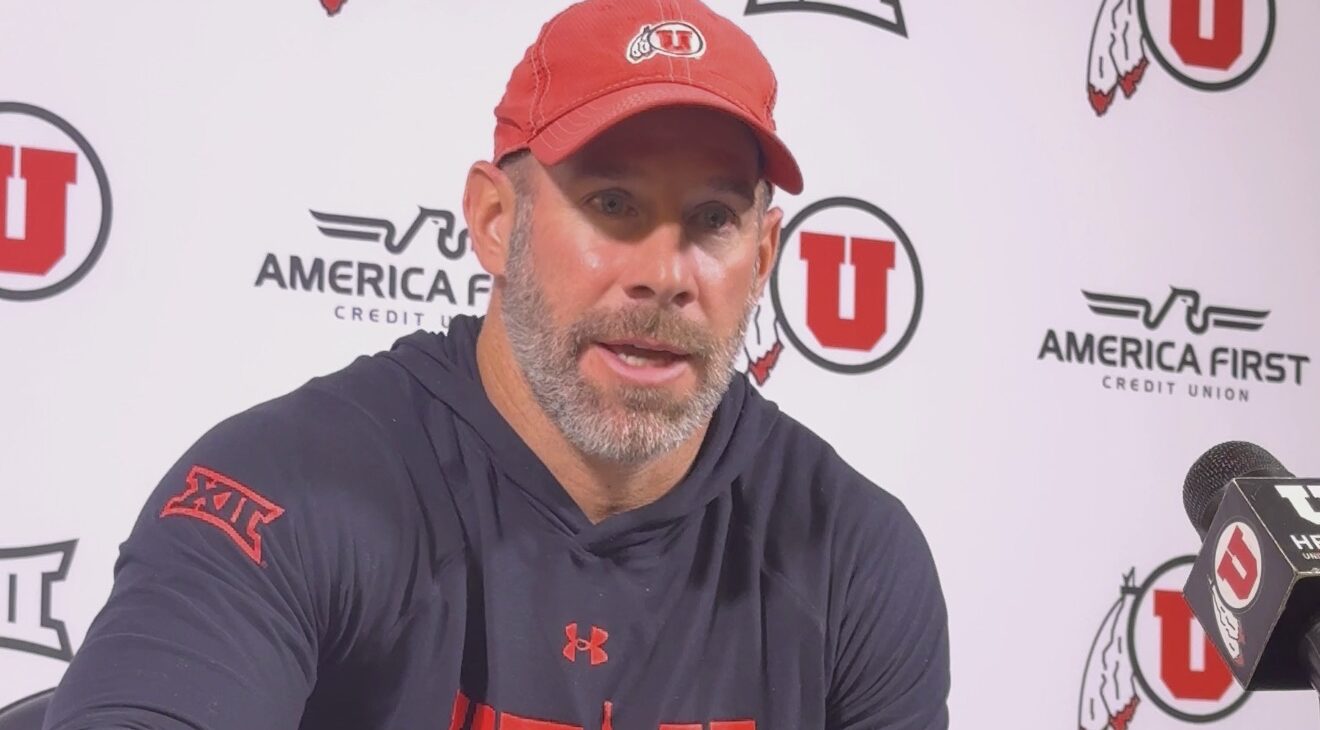
Morgan Scalley, Utah Football Honing In On New General Manager
Jan 26, 2026, 10:58 AM | Updated: Jan 27, 2026, 10:53 am

SALT LAKE CITY — Utah football has hired Joe D’Orazio as the program’s new General Manager. He is expected to lead a newly established front office framework under Morgan Scalley.
After spending a year as Riley’s director of football strategy and working as an offensive analyst, D’Orazio — an Ivy League product who manned the offensive line for the Penn Quakers — will arrive in Salt Lake City with 15 years of valuable experience under his belt.
Welcome 𝑩𝑨𝑪𝑲 to 𝐔𝐭𝐚𝐡‼️@coachdoraz joins the staff as our new 𝐆𝐞𝐧𝐞𝐫𝐚𝐥 𝐌𝐚𝐧𝐚𝐠𝐞𝐫 🙌#GoUtes pic.twitter.com/kfQDocCPxb
— Utah Football (@Utah_Football) January 26, 2026
Who Is Joe D’Orazio — And Why His Background Actually Matters
Start with the foundation. D’Orazio was a two-time First Team All-Ivy League center at University of Pennsylvania, a team captain, and part of back-to-back Ivy League championship teams.
Then there’s the Wharton piece. A Bachelor of Science in Economics from The Wharton School isn’t window dressing. In the NIL and portal era, “roster economics” is everything. D’Orazio will understand value, scarcity, marginal gains, and long-term resource allocation in a unique way.
Early on, D’Orazio lived in the grind:
-
University of Chicago (2011–12) as a tight ends coach — pure teaching, development, and fundamentals.
-
Utah graduate assistant (2012–13) — his first exposure to Utah’s culture and operational expectations, which matters more than people think. He’s not learning this place on the fly.
Then came the NFL education:
-
Special assistant to Andy Reid with the Kansas City Chiefs (2013–15) — essentially a graduate degree in elite organizational management under Andy Reid.
-
Philadelphia Eagles quality control / assistant WR coach (2016–17) — part of a staff that went on to win a Super Bowl. That environment teaches precision, accountability, and how decisions ripple across an entire organization.
- Columbia University (2019-23)— D’Orazio climbed the ladder from running backs coach to offensive coordinator in 2023. That matters because he understands how rosters develop over time, not just how they’re acquired.
- Baylor quality control (2024) — Learning the Big 12’s weekly realities, roster churn, and physical demands.
- USC Director of Football Strategy / Offensive Assistant (2025) — Effectively the top off-field football operator in USC Trojans’ machine under Lincoln Riley. That’s a role built around coordination, foresight, and managing complexity.
He’s done quality control in the NFL, developmental coaching at Ivy League and mid-majors, and offensive strategy — the kind of breadth that makes him uniquely suited to navigate both the competitive and administrative sides of roster building.
D’Orazio has lived at every layer of modern football — player, developer, schemer, organizer, and strategist. He understands locker rooms and balance sheets. Film rooms and scholarship math. Development timelines and market timing. All while his education centers around economics.
Why GM Matters in College Football
The general manager role isn’t a luxury add-on anymore. It’s the inevitable response to a sport that continually looks more and more “professional” with each passing day.
For decades, roster management lived on a whiteboard in the head coach’s office. Recruiting, retention, scholarships, development — it all flowed through one or two voices. That model worked when rosters were stable, NIL didn’t exist, and the portal was an exception, not a calendar event.
The shift to a true front office, with a real GM — is what separates programs that control chaos from those that react to it. Utah hiring D’Orazio is an acknowledgment of that reality.
-
The transfer portal churns faster than offensive play clocks. Windows open, players leave, tampering happens, and decisions have to be made before staffs even finish self-scout.
-
Rev share is no longer about “getting a deal,” it’s about allocation. Spend too much in one room and you create imbalance elsewhere. Spend too little and you bleed starters.
-
Scholarship math and roster timing are statistical warfields. Who’s draft-eligible, who’s portal-curious, who needs to be replaced now versus developed later — that’s not coaching intuition, that’s modeling.
The difference between a nine-win team and a playoff contender in 2026 isn’t usually raw talent. It’s talent optimization. A GM’s job is to ask uncomfortable questions before they become losses.
-
Do we actually need another portal receiver, or do we need retention at tackle?
-
Are we recruiting redundancy or solving future problems?
-
Is this rev-share/NIL spend producing continuity or just headlines?
Programs that win consistently aren’t just acquiring talent. They’re managing development curves, not just depth charts. That requires someone whose full-time job is seeing the roster two and three years ahead, not just next Saturday.
Utah Moves On From Previous Front Office Leaders
With D’Orazio’s arrival means additional changes. Longtime GM Robert Blechen, unfortunately, is no longer part of the football operations picture as the program restructures its front office hierarchy.
Utah leveled up the talent across the board under Blechen, which included the all-time highest ranked class in 2023. Named the general manager in 2022, Blechen previous served as Director of Player Personnel, while Utah made four trips in five years to the Pac-12 Championship Game.
Alongside that shift, other key support figures in the football personnel department — including Sam Morrissette, who had been serving as director of player personnel, and Reggie Dunn, known for his work in player experience and recruiting strategy — are expected to move on from the program as part of the broader overhaul.
Utah is hiring USC director of football strategy/offensive assistant Joe D’Orazio as its new general manager, sources tell @CBSSports.
Before USC, worked at Baylor, as offensive coordinator at Columbia and also in the NFL with the Eagles and Chiefs. pic.twitter.com/mbtNxRcIUJ
— Matt Zenitz (@mzenitz) January 26, 2026
The Bottom Line
In a sport where the portal, NIL, recruiting, and development timelines have turned roster building into a chaotic chess match, Utah adding a layer of front-office strategy signals they want to lead the chaos instead of being consumed by it.
Scalley’s seeming intention of hiring D’Orazio means future decisions — from who gets offers to how dollars and development paths are prioritized — will be informed by a blend of data, continuity strategy, and real football experience.