Jensen Points to “Little Things” as Utah Falls in Two-Point Battle with UCF
Feb 21, 2026, 10:43 PM | Updated: Feb 23, 2026, 11:23 am

Feb 21, 2026; Salt Lake City, Utah, USA; Utah Utes head coach Alex Jensen speaks with guard Terrence Brown (2) during the second half of a game against the UCF Knights at Jon M. Huntsman Center. Mandatory Credit: Rob Gray-Imagn Images
(2)

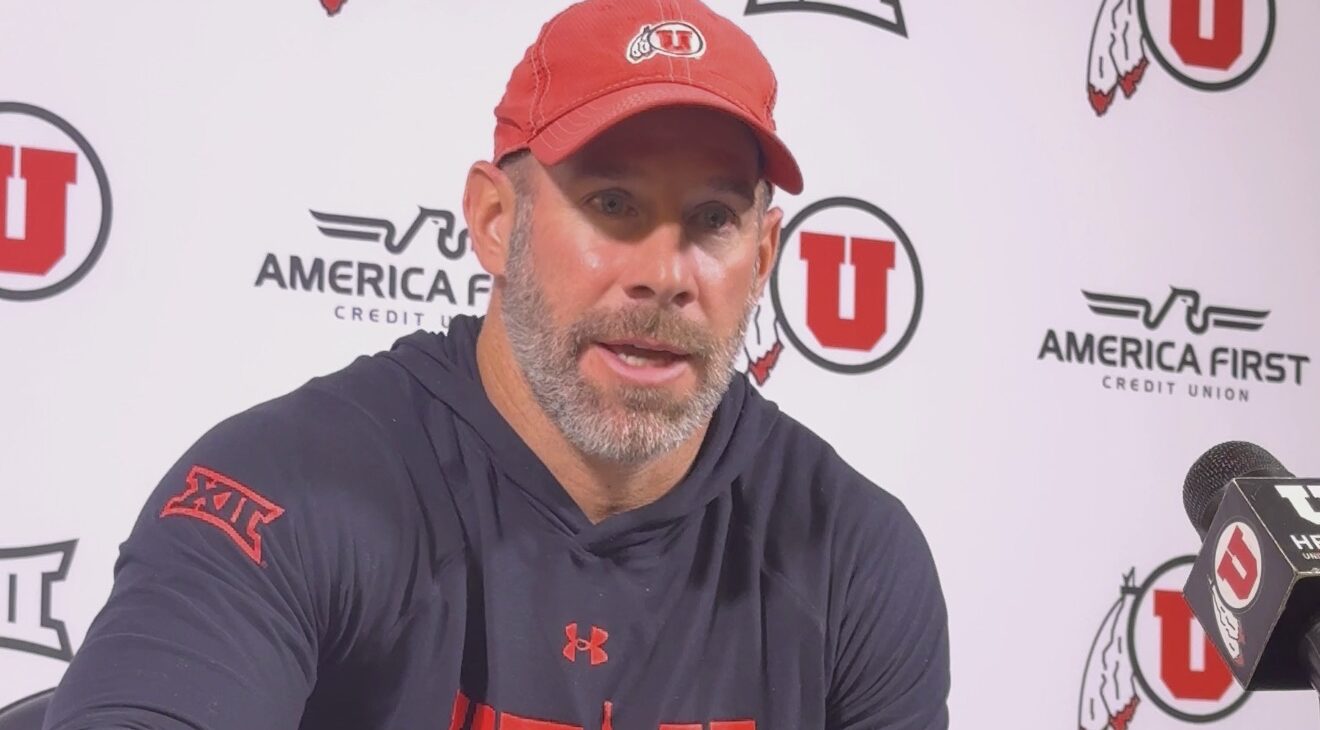
SALT LAKE CITY — Alex Jensen didn’t hide from it. He didn’t blame the whistle. He didn’t blame fatigue. He didn’t even blame the final possession. Instead, he pointed to the details.
After Utah’s 73–71 loss to UCF, Jensen’s message centered on the small moments that decide Big 12 games.
“We knew it was going to be a tough game,” Jensen said. “We got back from West Virginia at five o’clock Thursday morning. Everybody deals with it. I thought we did a great job in the second half battling through it. But we can’t dig ourselves those holes in the first half.”
Utah trailed 41–36 at the break and spent the rest of the night trying to climb out. They nearly did. But 18 UCF points off turnovers proved too large a tax.
“The live-ball turnovers… they were just killers,” Jensen said. “We warned that before the game. If you give 18 points off turnovers, it’s really hard. I feel bad for our guys because I think we had opportunities to do it tonight.”
No Moral Victories
Utah has been competitive — a win at West Virginia, narrow losses at Cincinnati and now at home. Jensen isn’t satisfied.
“I’m getting sick of the moral victories,” he said. “We were up five at Cincinnati. We very well could have won that one. I think we’re better than our record.”
Johnny Dawkins, now in his third year navigating the Big 12 grind, offered perspective on the learning curve.
“They’re in the best basketball conference in the country,” Dawkins said. “Until you’re actually in it, you don’t fully understand it. From top to bottom, every single team, every single night is going to be a fight.”
He praised Jensen directly.
“Alex is an incredible coach. He’s a smart guy. He’s going to be terrific. It’s just a function of growing together and figuring out what pieces you need.”
Johnny Dawkins: “Finding a way”
On the other side, UCF head coach Johnny Dawkins described the win as survival.
“This league is a gauntlet,” Dawkins said. “Every single night, every opponent… everybody’s just one basket away, two baskets away from records being a lot different.”
The difference Saturday, he said, was execution late. “I thought our guys did a great job just finding a way at the end to make plays and win the game.”
Dawkins specifically highlighted the turnover battle and defensive adjustments. Though UCF (9) only finished with two fewer turnovers than Utah, they capitalized much better by scoring 18 points off them, compared to just 7 points for Utah.
“That’s part of our system,” he said. “Creating points off turnovers is a big part of what we want to do. I thought we did a really good job of mixing our defenses up too. We played more zone than we have typically played this season.”
After starting the game in man defense, the Knights went to a zone halfway through the first half. That 1-3-1 zone altered the game’s tempo — something Jensen acknowledged.
“Playing a zone changes the tempo of the game,” Jensen said. “We get impatient. We get sped up. We’re learning to play at that tempo.”
The final (questionable) foul call
With the game tied at 71 and 3.7 seconds left, Utah fouled Themus Fulks, who calmly hit two free throws to seal it. Jensen didn’t deflect responsibility.
“That was a mistake by our coaching staff,” he said. “I’ll take the blame on that. We had a foul to give. I feel bad for Seydou because I think we put him in a bad spot.”
Utah’s intent had been to use the foul earlier, before UCF got into a scoring range. Instead, the timing came late as Fulks drove into the paint. The questionable nature of the call is that Fulks was awarded two free throws for a shooting foul. However, Fulks wasn’t even into his gather when Traore made contact, meaning the foul should’ve been on the floor and led to a 1+1 situation. Dawkins didn’t have a clear view of the call.
“It was tough for me to see,” he said. “I didn’t have a good angle on it. But the game was hotly contested. Both teams played their hearts out.”
In between McHenry’s three free throws that ultimately tied the game moments earlier, Dawkins called a timeout before the final attempt. He did so to clarify what they wanted to set up.
“There were a lot of emotions,” he said. “We wanted to make sure we called timeout, talked about exactly what we wanted to run, and made sure we settled our guys down.”
Even then, he admitted, Utah nearly stole it. “With 3.7 seconds, they still got a great shot off at the end. That’s the type of game it was going to be.”
The gamble is something Terrence Brown needs to learn from
One of the pivotal plays came when Brown gambled for a steal that led to an open UCF corner three. When asked about the play, Jensen’s assessment was layered.
“That’s the best and worst thing about TB,” he said. “He cares. He’s going to play hard. But that’s not the time. Just be solid. Let it come to you instead of trying to make it happen.”
Brown’s attempt was entirely a gamble. He abandoned his responsibility to try and make a play. To Jensen’s point, Brown did in fact play hard throughout the contest. Yet, this was a lesson that sometimes the best play is the safe play.
And Brown wasn’t alone. “Everybody has a turnover they’d like to take back,” Jensen said. “Those mistakes we have control over.”
A connected team — but details still matter
Jensen credited his players for staying connected during a brutal stretch that included long travel and emotional swings.
“Long road trips can be good,” he said. “You spend time together. I think they’re playing better together and off each other. When we make our runs, that’s usually what happens.”
But against UCF, the runs weren’t enough. “They fought,” Jensen said. “But you’ve got to start with that intensity. And the little things — starting with myself — we can all get better.”
In a league where, as Dawkins put it, “everybody’s one basket away,” the smallest moments decide everything. Saturday night, those moments tilted toward the Knights.
And for Utah, the frustration isn’t effort. It’s how close they are — and how little margin there is for error.