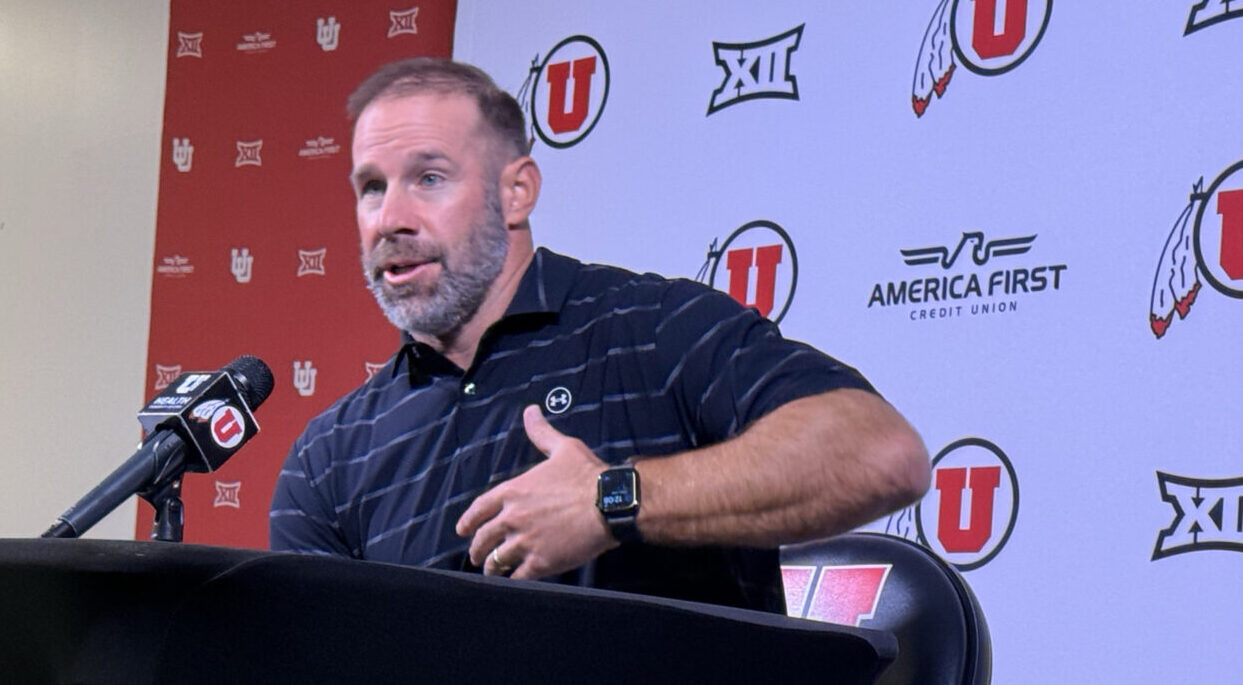
Morgan Scalley takeaways: Utah preparing for a significant step up against Arkansas
Sep 7, 2026, 1:33 PM

SALT LAKE CITY — Turning the page from the season opener, Morgan Scalley met with the media for his Week Two press conference ahead of the team’s big showdown with the Arkansas Razorbacks.
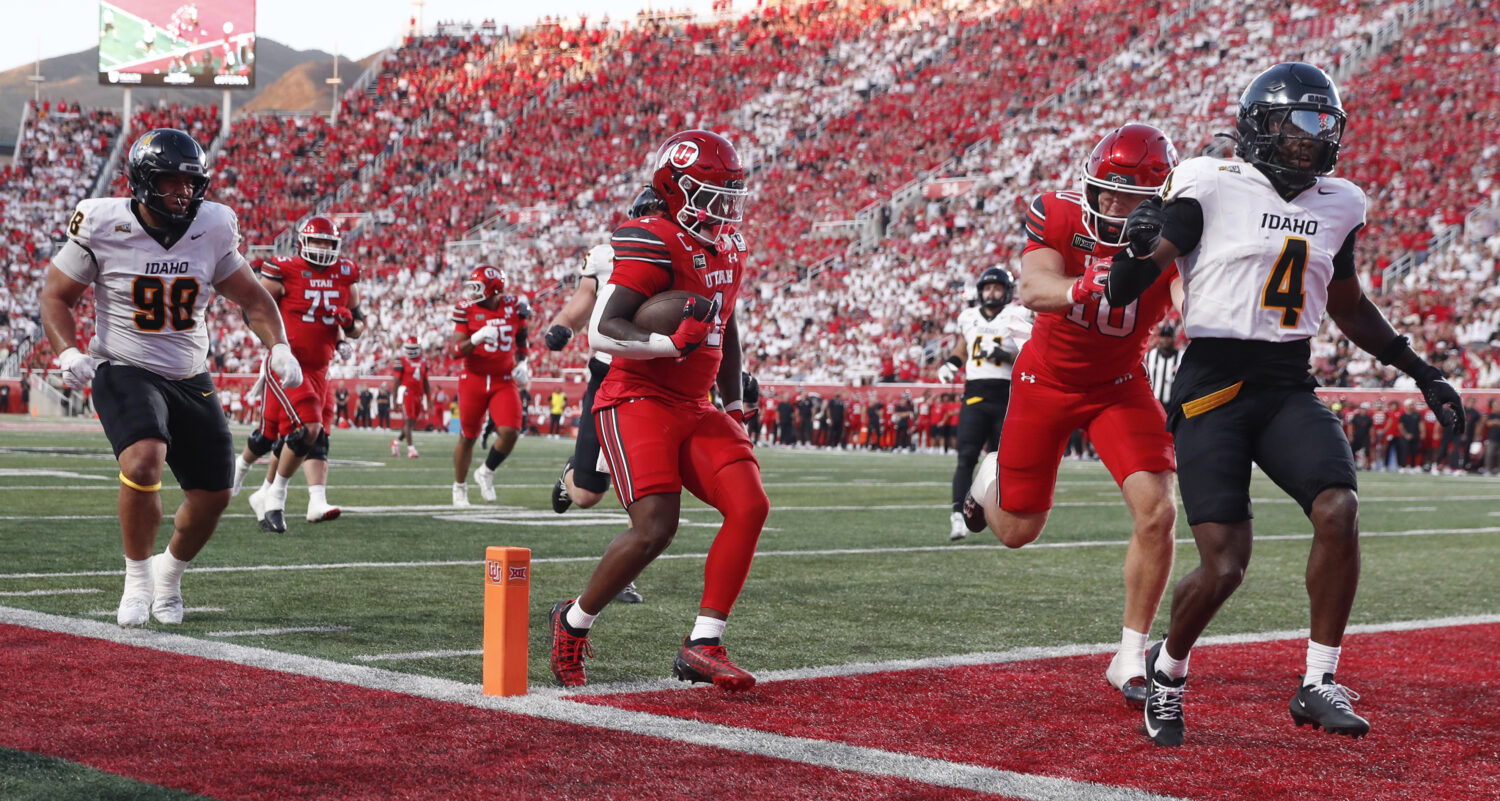
Utah accomplished almost everything it wanted in a 66-14 season-opening win over Idaho. The Utes generated 633 yards, incorporated a large number of players offensively and created consistent pressure defensively.
Scalley was pleased with what the film revealed, particularly along the defensive line and within the offense’s expanded collection of personnel packages. They also emerged from the game with plenty of correctable mistakes, the challenge is carrying the positives and correcting mishaps for a more demanding matchup against Arkansas.
The Razorbacks will bring SEC size, speed and a dual-threat quarterback to Rice-Eccles Stadium. Scalley identified the line of scrimmage as the defining challenge on both sides of the ball.
Here are the biggest takeaways from Scalley’s Monday press conference.
Arkansas will provide an immediate talent upgrade
Scalley confirmed that Utah’s preparation process won’t change because of the opponent, but there was no attempt to pretend Arkansas represents anything other than a substantial step up in competition level.
The Razorbacks are big and physical along both lines, with speed at running back and wide receiver. Defensively, Arkansas is also big and athletic up front and have the secondary to present some challenges.
“They’re big, big up front,” Scalley said. “That’s again going to be the challenge, that battle up front, both on the offensive and defensive sides.”
That makes this an immediate measuring-stick game for a Utah roster with several new pieces in important roles.
The Utes controlled Idaho with their depth and athleticism, but there were still stretches when the Vandals found movement in the running game. Utah also rotated multiple combinations along its offensive line before playing with more cohesion as the game progressed. Arkansas should provide a much more honest evaluation of both units.
“We know that we’re going to see an upgrade in talent,” Scalley said. “But the preparation has to be the same.”
Utah also understands the larger significance of hosting an SEC opponent. Arkansas will be only the second SEC program to play at Rice-Eccles Stadium, following Florida’s visit in 2023.
“You definitely want to show well for the conference,” Scalley said. “We want to represent the Big 12. We want to represent the state of Utah the right way.”
Eric Weddle’s Ring of Honor moment carries significance
Former Utah safety Eric Weddle will enter the program’s Ring of Honor this weekend, giving the Arkansas game additional significance for Scalley.
Scalley remembered Weddle arriving at Utah with an advanced understanding of the game, exceptional athleticism and enough confidence to immediately answer questions in the safety room. That confidence once resulted in veteran safety Dave Revill pinning Weddle down while teammates shaved a reverse mohawk into the freshman’s beloved hair.
The story was amusing. Scalley’s larger point was sincere.
Weddle’s football accomplishments speak for themselves, but Scalley focused just as much on the former All-Pro’s service, family and continued representation of Utah.
“The amount of lives he’s blessed in service, the father that he is and how he represents this university — man, I couldn’t be more excited for him,” Scalley said.
Weddle’s recognition will provide an appropriate backdrop for a game that should reveal considerably more about the current Utes.
Idaho offered Utah an opportunity to unveil its new systems, develop depth and build confidence. Arkansas will determine how much of that performance travels when the opponent becomes bigger, faster and far less forgiving.
Utah expects to settle on a starting offensive line
Utah used a rotation at guard against Idaho, giving several linemen an opportunity to earn meaningful snaps. All in all, 10 different linemen saw action Thursday night.
Scalley liked the way the group improved throughout the game and noted that the Utes did not allow a sack. However, Devon Dampier absorbed more contact than Utah wanted, particularly early.
Some of those hits were not strictly protection failures. Dampier held the ball on a few plays and kept it during read-option sequences in which the quarterback is naturally exposed to contact. Still, preserving Dampier will remain one of Utah’s most important responsibilities throughout the season.
“We’d like to definitely take those hits off of him,” Scalley said. “We don’t want him getting hit as much as he was getting hit early in that game.”
The experimentation up front may also be nearing its conclusion.
“We’ll settle in on a starting five this week that hopefully can last us throughout the game,” Scalley said.
Utah was without key offensive lineman Keith Olson, but seemingly could be welcoming him back this weekend. That would be a big boost to the offensive line, as Olson is one that Jordan Gross singled out as a starter in the very first week of fall camp.
Offensive distribution could make Utah difficult to defend
Braden Pegan supplied several of Utah’s most memorable receptions against Idaho, but Scalley was more interested in how many different players became involved.
Dampier completed passes to eight wide receivers. Hunter Andrews contributed at tight end, the running backs were incorporated into the passing game and Utah used multiple personnel groupings throughout the night.
Ricky Johnson, Creed Whittemore, Larry Simmons and Mana Carvalho were among the players who took advantage of their opportunities.
“The biggest thing was the amount of guys that were involved in the offense,” Scalley said. “That can create issues when you’re scheming for an offense. Who are their guys? Who do we need to take care of? When you’ve got that many guys getting the ball, it can be a tough one.”
Utah does not need every eligible receiver to become a featured part of the offense each week. It does need defenses to respect the possibility. McGiven continually changed formations and personnel while creating touches for running backs, tight ends and complementary receivers.
That diversity becomes more meaningful against Arkansas. Utah will not possess the same overwhelming athletic advantage it enjoyed against Idaho, so forcing the Razorbacks to defend the entire formation — and the entire roster — could be essential.
Scalley also reiterated that Utah’s passing game begins with physicality on the ground.
“If you don’t have that physical run game, it won’t matter,” Scalley said. “It starts up front, and then everything else is basically what a defense is trying to do to you.”
The Dampier-Byrd Ficklin package offers possibilities — and risk
Utah placed Dampier and Byrd Ficklin on the field together multiple times against Idaho, providing an early look at one of McGiven’s more intriguing personnel packages.
Ficklin’s versatility makes the combination possible. He can operate as a quarterback, catch the ball like a receiver and become a fly-sweep threat with his speed. Dampier, meanwhile, is comfortable functioning as a runner when Ficklin takes the snap.
That gives Utah several options without changing personnel. It also places both quarterbacks in potential contact situations.
“Dangerous to the defense, but also dangerous on our part,” Scalley said. “We’ve got two of our guys out there, and so we don’t want necessarily Byrd getting too many hits.”
Scalley described Ficklin as having an “unreal skill set,” but Utah will remain selective about when and how it uses the package.
“You’ve really got to be safe with it,” Scalley said. “You’ve got to pick your times when you use them.”
The package does not need to produce a trick play every time it appears. Its value also comes from forcing defensive coordinators to spend preparation time accounting for a formation Utah may use only a handful of times.
Defensive-line film was more encouraging than the rushing totals
Idaho’s success on a pair of touchdown drives raised understandable questions about Utah’s defensive front, but Scalley came away encouraged by several individual performances.
He highlighted Carson Kaufusi, Ji Moe and Lance Holtzclaw after reviewing the film. Kaufusi played well inside, while Holtzclaw consistently affected the quarterback off the edge.
“I thought Lance Holtzclaw was all over the field providing pressure,” Scalley said.
Utah recorded numerous quarterback hits and regularly forced Idaho to operate outside the intended timing of its passing game. That was a central component of defensive coordinator Colton Swan’s plan.
There are still corrections to make, particularly against the run, but Scalley indicated confidence in the depth behind Utah’s starters. Michael Ta’atioli is getting healthier, while Semi Taulanga and Sione Motu’apuaka provided encouraging snaps against Idaho.
Utah can also move its “Rhino” tight ends back to defensive tackle if needed. Both players began their careers at the position before taking on their offensive roles.
“I feel good about that depth,” Scalley said. “I really do.”
Arkansas will test that confidence. The Razorbacks’ combination of size up front, explosive running backs and a physically built quarterback will require Utah to tackle with considerably more force and consistency.
Utah’s pressure plan will remain opponent-specific
Utah played aggressively against Idaho, frequently using zone pressures to create extra bodies around the line of scrimmage.
Scalley emphasized that Swan is not pressuring simply for the sake of being aggressive. Utah’s approach is determined by the opponent’s formations, tendencies and quarterback usage.
“If a team is going to try and run the ball with their quarterback, we’re going to try and generate a little bit more pressure — the plus-one in the box,” Scalley said.
That calculation will carry into Arkansas.
The Razorbacks have a larger dual-threat quarterback capable of extending plays and running through weak tackle attempts. Arkansas may not build its offense around designed quarterback runs, but Scalley said those concepts remain available within the system.
Utah’s pass rush must balance pressure with lane integrity. Sending a fifth defender can help contain the quarterback, but only if rushers remain disciplined enough to prevent escape routes.
“You’ve got to think about lane integrity and adding that fifth guy,” Scalley said, “and just making sure that you’ve got enough bodies in there to make life uncomfortable for him.”
Daniel Bray in concussion protocol
Running back Daniel Bray sustained a concussion after playing only a few snaps against Idaho and remains in the protocol.
Scalley said Bray appears to be progressing toward a return, but the nature of the injury makes his availability difficult to predict.
“It looks like we’re on track to have him back,” Scalley said. “But with concussions, you never know day to day how they handle everything. We’re making sure that he’s safe and ready to go.”
Utah has considerable depth at running back, which should prevent the Utes from rushing Bray back before he is fully cleared.