Morgan Scalley: “Utah Through and Through” — Inside The Utes’ New Era
Mar 5, 2026, 1:39 PM | Updated: 1:56 pm

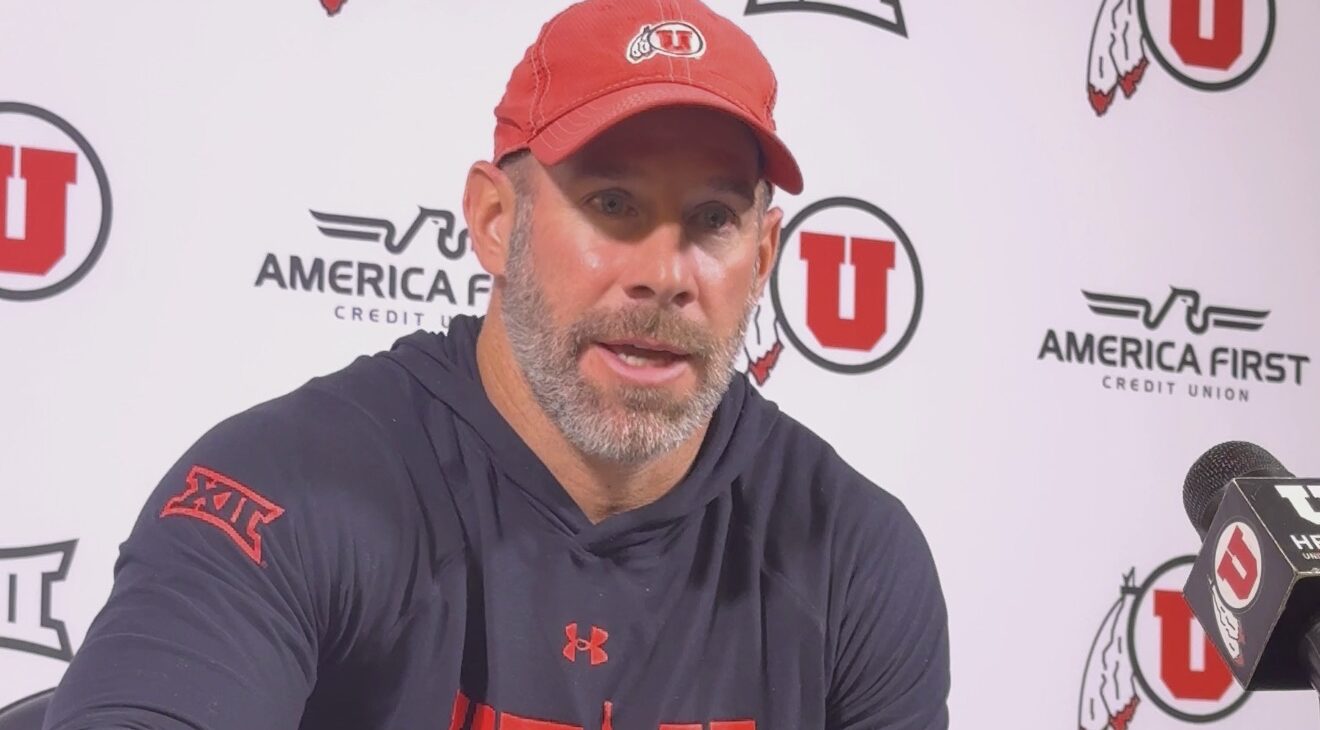
SALT LAKE CITY —Spring football is approaching in Salt Lake City, but for Utah head coach Morgan Scalley, the shift into the program’s next chapter has already begun.
Appearing on Big 12 Radio this week, Scalley spoke candidly about the transition into the head coach role, the evolution of Utah’s roster, and the philosophical foundations that will define the program moving forward.
And in typical Scalley fashion, the message was simple: the standards aren’t changing.
A Utah lifer takes the reins
Few coaches in college football are as intertwined with one program as Scalley is with Utah.
He played for the Utes from 2001–04 and has been on the coaching staff since 2006. That history, he said, defines who he is and how he approaches the job.
“I would say I am a lot of fun… but I’m competitive as they get. I’m Utah through and through. I’ve been coaching at this place since 2006, played from ’01 to ’04. My logo has never changed and hopefully it never will —until they kick me out of here. I absolutely love this place and what it has to offer young men.”
The transition to head coach came in unusual fashion after longtime head coach Kyle Whittingham departed for Michigan. Scalley acknowledged the circumstances weren’t what he initially expected, but emphasized the respect he still has for the coach who built the modern program.
“I have so much respect and love for Kyle Whittingham, and I know he’s going to do amazing things at Michigan. I’m excited and grateful the University of Utah had faith in me to take over the reins.”
That faith came with an immediate test — his first game as head coach being the bowl game in Las Vegas.
“It was definitely hectic when it all started out… when you’re being told your first game is going to be the bowl game in Las Vegas, make sure you keep your guys out of trouble.”
Utah responded with a dominant bowl performance, giving Scalley early momentum heading into the offseason.
“I’m excited about both quarterbacks.. and both have continued to develop this offseason,” he shared. “Getting the guys in from the portal, developing the guys in the program, excited for spring to get going.”
Spring questions begin in the trenches
As Scalley evaluates his roster entering spring camp, the focus starts where it always has in Salt Lake City — the line of scrimmage.
Utah must replace multiple NFL-caliber players along the offensive front, including potential first-round picks. Scalley believes the foundation is already in place but acknowledged that the coming months will determine who steps into those roles.
“Offensive line and defensive line, that’s where we really have to make our money this offseason — getting the guys we brought in from the portal, developing the guys already in the program, and adding the young players we recruited.”
Two big transfer additions are former Montana State lineman Cedrick Jefferson and former Ohio State lineman Isaiah Kema. Yet, the biggest addition might be five-star recruit Kelvin Obot, the highest-rated recruit in program history.
“You add Kelvin Obot… and he’s every bit of what he’s advertised to be,” Scalley described. “Spencer Fano came in, played as a freshman, and I would anticipate the same thing from Kelvin, depending on how he develops, but that’s our job.”
The offensive line will also be guided by a high-profile new coach: former NFL Pro Bowler Jordan Gross, a Carolina Panthers Ring of Honor member.
“I don’t know that I could have gotten a better offensive line coach to replace Jim Harding than Jordan Gross. He’s an unbelievable teacher and a really good man.”
Utah’s offense may be more explosive
While Utah’s identity has long centered around physical football, Scalley hinted that this year’s offense could feature more explosive skill talent than the program has had before.
“I do think we have a better receiving corps than we’ve ever had here at the University of Utah,” he stated.
That group includes several portal additions and emerging contributors.
“Not only Braden Pegan, but Kyri Shoels from San Jose State, but you look at what Larry Simmons did on the back half of the season and the plays he made,” he shared.
Those three combine for nearly 2,000 yards and 13 touchdowns in 2025 production, and should be viewed as the top three in the room.
Scalley did highlight a name that hasn’t been talked about as much as the other additions Utah made.
“A name people maybe haven’t heard as much but I’m expecting big things from is Ricky Johnson,” he shared.
Johnson is a 6-foot-2, 185 pound newcomer from the SEC. Though production is minimal, Johnson comes to Utah alongside new receivers coach Chad Bumphis from Mississippi State.
Utah also returns Creed Whitemore in the slot and welcomes back Daidren Zipperer, who missed much of last season due to injury. Whittemore came on in the final few regular season games, finishing with 12 receptions for 92 yards and a score. Meanwhile, Zipperer had a similar breakout in 2024, finishing the season with 11 receptions for 122 yards.
Add in versatile tight ends like Will Monney, Noah Bennee, and Kanai Lopes, along with Utah’s unique “rhino” packages that will prominently feature fan favorites Semi Taulanga and Sione Motuapuaka, and Scalley believes the offense will have a wide range of weapons.
“It’s a fun package when you look at all the different things you can do with your skill players — but also with some of those bigger players.”
New offensive coordinator Kevin McGiven will orchestrate the system, though Scalley emphasized the philosophy will remain player-driven.
“It’s about the players, not the plays. Taking your best athletes and finding ways to get them the ball.”
Physicality still defines Utah football
Even as the program evolves schematically, Scalley made clear that Utah’s foundational identity will remain intact.
He pointed to one principle that connects his leadership style to Whittingham’s: physical football wins championships.
“You cannot win a championship if you’re not physical. You have to practice physical or you won’t get there.”
But the real difference-maker, he argued, isn’t scheme. Behavior and execution is.
“I think people get caught up in scheme at the expense of behavior. I could have an A+ scheme and C- behavior… but my results will reflect C- because the scheme doesn’t matter if you can’t execute.”
Instead, Utah’s emphasis will remain on technical execution — tackling, leverage, fundamentals — and holding players accountable to those standards.
“To me it’s defining for your players what it takes to be elite at each position technically, and then we’ve got to be great teachers and hold those guys accountable to it.”
Defense aims for continuity
Scalley built his reputation as one of the nation’s top defensive coordinators, and he expects the Utes’ defense to remain a hallmark of the program.
With Colton Swan now coordinating the unit, fans shouldn’t expect dramatic schematic changes.
“Not much is going to change schematically. We have the same philosophy.”
Utah returns strong depth at linebacker and safety, while several new faces will compete at cornerback and defensive tackle this spring.
Scalley highlighted several players he expects to make an impact:
- Lance Holtzclaw
- Kash Dillon
- Ethan Day
- PJ Takitaki
Utah’s Paul Fitzgerald is expected to be a part of the rotation but will remain unavailable through spring ball as he continues to recover from an injury suffered during the season.
Scalley highlighted positions — defensive tackle, end and cornerback — that will be key development areas for the staff during spring practice.
Collaboration shaping the program
One unexpected twist of Scalley’s new role has been spending more time inside the offensive meeting rooms.
The defensive-minded coach admits he enjoys challenging the offense with ideas designed to attack defenses.
“Being a defensive guy for as long as I’ve been, you know what gives you fits. So it’s been fun being in the offensive room and telling them, ‘Hey, you should try this — this would give me a headache.’”
That collaborative approach reflects how Scalley plans to lead the program: shared ideas, unified philosophy, and relentless competitiveness.
The Bottom Line
Morgan Scalley isn’t reinventing Utah football, he’s leading it through an evolution. The physicality, the accountability, and the development pipeline that defined the Whittingham era remain intact.
What’s new is a deeper receiver room, fresh offensive ideas under Kevin McGiven, and a staff built to navigate the modern realities of the transfer portal.
As Scalley put it, success ultimately comes down to execution. “You have to recruit, develop, and manage… and eventually you have to play the game. Then we’ll find out if we’re ready.”