Utah Basketball: What’s a successful offseason look like?
Apr 8, 2026, 4:58 PM | Updated: Apr 9, 2026, 8:36 pm

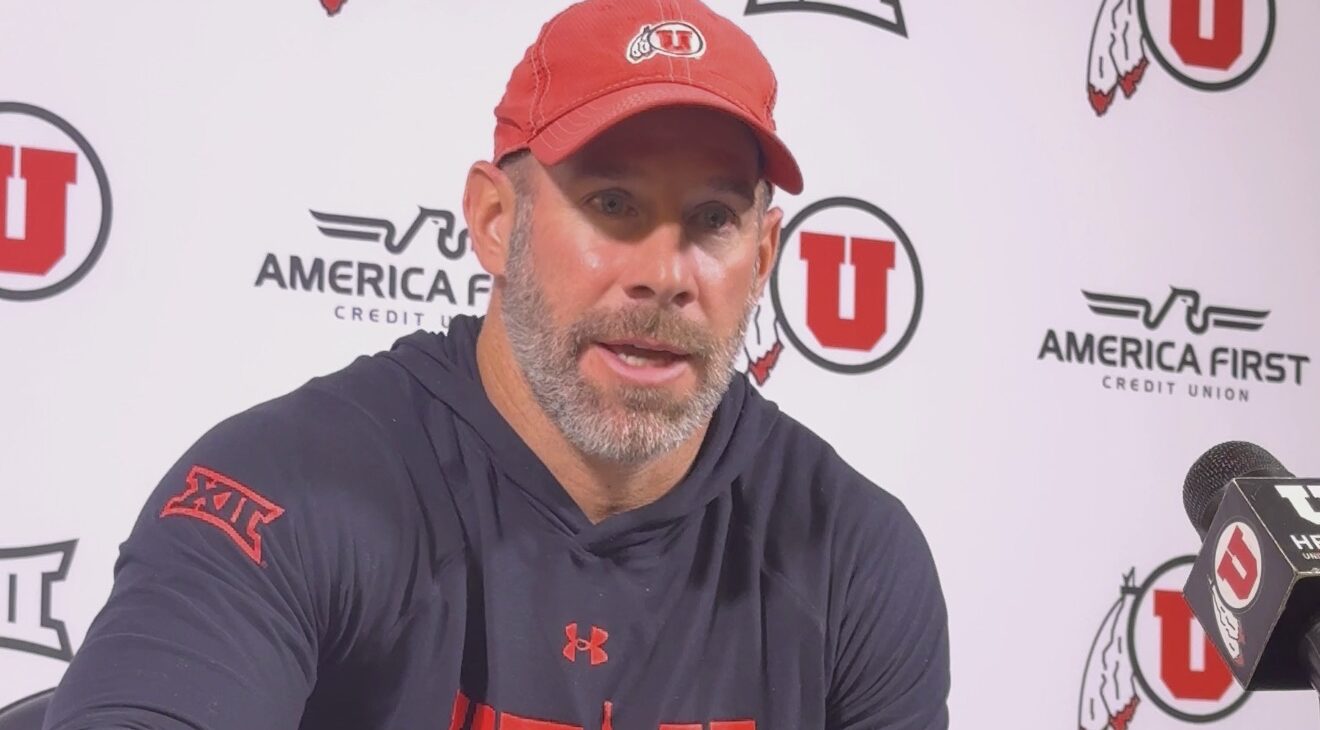
Feb 24, 2026; Salt Lake City, Utah, USA; Utah Utes head coach Alex Jensen during the second half against the Iowa State Cyclones at Jon M. Huntsman Center. Mandatory Credit: Rob Gray-Imagn Images

SALT LAKE CITY — The question isn’t whether Utah basketball will change this offseason. It’s how much.
With the transfer portal cycle fully underway, Utah basketball is staring at what looks like a full-scale roster reset. The majority of last year’s rotation has entered the portal or has had eligibility expire.
There are only a handful of players as realistic return candidates. That reality forces a necessary conversation: what does a successful portal season actually look like?
A roster flip — whether you like it or not
Let’s start with the part fans are still wrestling with. This is not a “run it back” situation.
The Utes are coming off a 10-win season, and while continuity is still somewhat valuable in college basketball, this season’s roster is not one to cling to for the sake of familiarity. Instead, this offseason is likely to be a near-complete overhaul.
So far, Utah has seen Terrence Brown, Keanu Dawes, Seydou Traore, Josh Hayes, Alvin Jackson, Elijah Moore, and Jakhi Howard enter the portal.
There are a few names worth monitoring as returners — Lucas Langarita’s return can be written in ink, he’ll be back next season. While players like Kendyl Sanders, Babacar Faye, Obbomate Abbey, and Jacob Patrick should each be penciled in instead because there’s a chance each might need to be erased.
Again, continuity certainly matters, and that is value that Sanders, Faye, Abbey, and Patrick all offer. But Utah should prioritize upgrading as much of the roster as possible over building with pieces that may be better served at a lower level.
A different approach to the portal
Under Alex Jensen and general manager Wes Wilcox, Utah’s portal strategy is expected to look different than it has in the past.
There’s an NBA influence here — one that treats the portal less like a final exit and more like a market.
Players entering the portal won’t automatically mean the door is closed. Instead, there’s a possibility of a more fluid process, where players test their value and Utah evaluates whether to match it — a concept similar to restricted free agency.
That doesn’t guarantee retention. In fact, history still says most players who enter the portal will leave.
But it does signal a philosophical shift: Utah is operating with a more open, evaluative approach rather than a rigid one.
This sort of evaluative approach will be a factor for certain players who have already entered the portal, as well as for those who haven’t.
Defining success — and raising the standard
Here’s where the conversation gets real. Portal prospects will emerge, as will international players, and Utah needs to capitalize.
A successful portal season is all about adding impact. And for Utah, that starts with one position above all others:
1. Land a true point guard
Last season, Terrence Brown carried much of the offensive burden, but what this roster lacked was a true floor general — someone who elevates everyone else.
If Utah wants to get back to the NCAA Tournament, it starts with improved point guard play. It should be a point guard who can:
- Control the floor, create for others
- Score at all three levels
- Maintain efficiency in Big 12 play
Utah’s search for a quality point guard (and other positions) will stretch overseas as well. The Utes need to improve their shooting, which will likely be a considerable factor in their search here.
2. Add three other starter-level players
Utah needs to walk out of this portal cycle with four guys capable of starting on a Big 12 level — a point guard and three additional impact players — to reshape the top of the rotation.
Those three other spots will likely be a combo guard, small forward, and another big.
Internal and incoming guys like Lucas Langarita, Fynn Schott, and Zati Loubaki factor into the mix, but relying solely on them would be a gamble that Utah should avoid.
The portal has to deliver proven impact and production to Jensen’s roster. This past season, Utah had three players with a double-digit efficiency rating, whereas only one team in the top half of the Big 12 had less than five players with a double-digit efficiency rating.
3. Improve size across the roster
This was Utah’s most glaring weakness last season. And it wasn’t just at center. The lack of size showed up everywhere — in the backcourt, on the wings, and in the frontcourt depth. In the Big 12, that’s a losing formula.
Size isn’t just height — it’s strength, length, and the ability to hold up physically over a full conference schedule. With the aforementioned Schott and Loubaki, Utah will have a couple of bigs that help this endeavor.
The possibility of bringing back Faye is another potential positive. However, given Faye’s injury history, it would be wise of Utah to secure another big to shore up depth and protect themselves from a repeat of this past season.
4. Add real defensive pieces
Jensen harped about the defensive end of the floor all season long. Utah showed flashes defensively last season but lacked consistency. That has to change — and it starts with recruiting personnel that enjoy the competition on that side of floor.
This is expected to be a big priority in the roster construction. Utah’s lowest individual defensive rating was 114.7. Compare that to Houston, a program Jensen has often referred to, and the highest individual defensive rating was 102.5, that’s a significant difference.
Utah will likely look for players who:
- Take pride in defense
- Can guard multiple positions
- Disrupt rhythm, not just react
- Metrics, sub-100 defensive rating
Utah offered little resistance to opposing offenses and if this program is going to take a step forward, it has to become more difficult to play against.
Building toward something bigger
There’s an important layer to all of this. Last offseason, Utah’s staff didn’t have time. Hired late in the cycle, Jensen and his group were forced to build a roster on the fly, without the benefit of months-long preparation that most programs rely on.
That matters. This year is different.
With a full season to evaluate talent, build relationships, and identify fits, this is the first true opportunity for Jensen & Wilcox to construct a roster aligned with their vision.
In the Big 12, a lot of success is determined by the resources available to these programs. Though improved from previous years, Utah was still in the bottom quarter of the league this season. There are a lot of people around the program that want Jensen to succeed and have stepped up to provide the program with the resources needed to outfit a competitive roster in the Big 12.
There is a plan in place, there are improved resources available to the program, now, it’s all up to the staff to execute this offseason.
The Bottom Line
Utah doesn’t need a tweak — it needs a transformation.
With most of the roster already gone, this offseason is about building something functional, physical, and competitive in the Big 12, not preserving what didn’t work. That means landing a true point guard, adding multiple starter-level players, getting bigger across the board, and — most importantly — fixing a defense that simply wasn’t good enough.
There’s a real vision in place, and the staff has had the time to prepare for it, now it’s all about executing. But in a league that exposes weakness quickly, execution isn’t optional — it’s everything.