First impressions: Utah’s guards provide encouraging start in exhibition win over UNLV
Oct 7, 2026, 11:09 PM | Updated: 11:52 pm

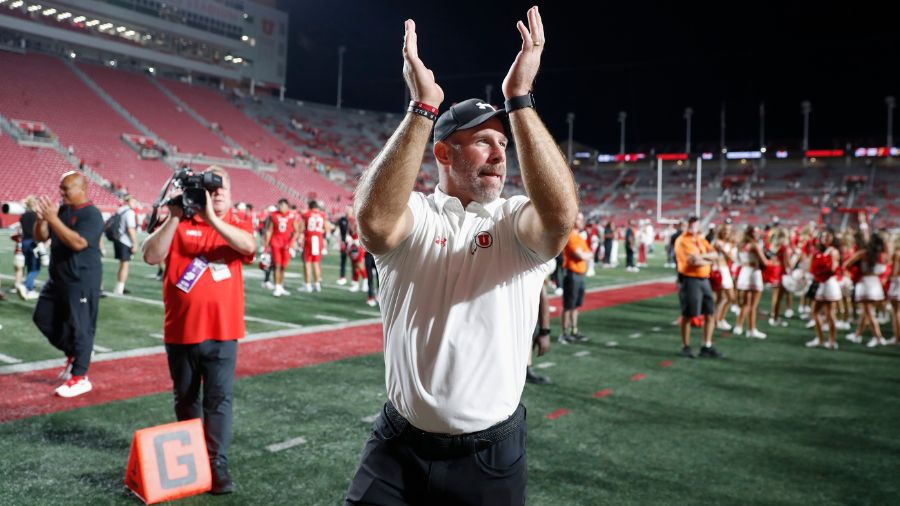
Jan 31, 2026; Salt Lake City, Utah, USA; Utah Utes head coach Alex Jensen reacts after a play against the Oklahoma State Cowboys during the second half at Jon M. Huntsman Center. Mandatory Credit: Rob Gray-Imagn Images

LAS VEGAS — Utah basketball’s first look against outside competition offered Alex Jensen something useful: stretches of promising basketball, a few uncomfortable minutes and plenty to bring back to practice.
The Utes defeated UNLV 79-69 in Wednesday’s exhibition at the Thomas & Mack Center, with Trey Campbell and TJ Burch combining for 33 points. Utah built a 17-point first-half lead, weathered a cold shooting stretch and responded when the Rebels pulled within six late in the second half.
It was an encouraging introduction, with some important pieces still missing. Utah played without Babacar Faye and Fynn Schott, both expected to be significant contributors. UNLV was missing two key players of its own in Tylin Jones and AJ Storr.
For Jensen, the opportunity to evaluate a new group against outside official competition was valuable.
“First, the exhibition games are great for us because you get to play against somebody else,” Jensen said. “I don’t think it’s changed where we need to get to, but with a whole new team, it’s good to play together.”
The value was in the early clues: who could create offense, how players contributed when shots weren’t falling and where the Utes still need to improve.
𝗨𝗧𝗘𝗦 𝗪𝗜𝗡 ‼️
#GoUtes https://t.co/vAnmUVC8lk
— Utah Basketball (@UtahMBB) October 8, 2026
Trey Campbell, TJ Burch were impressive
Campbell and Burch supplied Utah’s scoring punch, but their defensive work was just as impressive, particularly when UNLV threatened late.
Campbell scored 11 first-half points on 3-of-4 shooting from deep and finished with 17 points, three assists, two steals and one turnover. When his shooting cooled, he continued to contribute, turning a steal into the transition layup that capped Utah’s 7-0 run for a 71-58 lead.
Burch added 16 points, five rebounds and four steals without a turnover. Three of those steals came in the final five minutes, repeatedly denying UNLV opportunities to cut into the lead. He took the ball from MJ Thomas during the 7-0 run, then intercepted two passes just 16 seconds apart. The second led to Holcombe’s basket for a 73-62 advantage with 1:43 remaining.
Burch also went 8-of-10 at the line and scored six points in the final minute. Together, the guards combined for six steals, one turnover and a 12-for-14 showing on free throws. Their ability to disrupt possessions and turn defense into opportunities was among Utah’s most encouraging signs.
- Utah scoring: Trey Campbell 17, TJ Burch 16, Jack Holcombe 9, Taison Chatman 9, Malek Gomma 6, Alec Anigbata 6, Jaxon Johnson 6, Zati Loubaki 5, Lucas Langarita 3, Lukas McCanna 2, Styles Clemmons 0.
- Leading rebounders: Holcombe 6; Burch, Gomma and Anigbata 5 each.
- Assists: Holcombe 4; Campbell and Chatman 3 each.
- Team shooting: 24-of-60 FG (40%), 10-of-32 from three (31.3%), 21-of-25 FT (84%).
Better movement, more defensive activity
The most encouraging difference from last season was how connected Utah looked on both ends. The ball moved quickly and decisively from side to side, with players making the next pass and keeping the offense moving. Ten assists on 13 first-half baskets reflected that rhythm, but the pace of the decisions stood out just as much.
Defensively, Utah was more active and disruptive. Campbell and Burch helped set that tone, combining for six of the Utes’ 12 steals. When the offense stalled in the second half, Utah strung together stops and created extra opportunities through takeaways. That was an encouraging way to respond when shots stopped falling.
There is a lot of work to do, particularly on the glass and with foul discipline. And one exhibition against a shorthanded opponent only tells us so much. But the quicker ball movement and more engaged defense were noticeable improvements from last season, giving Jensen a promising starting point.
Jekyl & Hyde shooting
Utah made nine first-half 3-pointers, with five players connecting. The ball moved quickly and decisively from side to side, keeping the defense moving and allowing Utah to find the next opportunity without letting possessions stall.
Ten of its 13 baskets before halftime were assisted, and the Runnin’ Utes built a lead of as many as 17 points. Campbell, Taison Chatman and Jaxon Johnson combined for seven of those 3-pointers, giving Utah several sources of perimeter scoring.
The second half provided a different test. Utah went 1-for-11 from three and experienced a stretch of nearly five minutes without a field goal.
Jensen credited UNLV’s adjustment for disrupting that rhythm.
“They went small, and then they started switching everything, which we struggled with,” he said. “It sped us up a little bit.”
Utah missed some open looks early in the half, but Jensen also wanted more patience and sustained ball movement.
“We just got to do a better job of controlling the tempo and getting the ball to the second, third side,” he said.
- First-half shooting: 13-of-31 FG (41.9%), 9-of-21 from three (42.9%), 10-of-11 FT (90.9%).
- Second-half shooting: 11-of-29 FG (37.9%), 1-of-11 from three (9.1%), 11-of-14 FT (78.6%).
Some possessions stalled, while others produced quality looks that simply didn’t fall. Utah found other answers, converting 10-of-18 attempts inside the arc after halftime and increasing its paint production from eight points to 20.
The two halves may have offered an early look at Utah’s shooting potential at both extremes. When the ball moves and multiple shooters connect, the Utes can put pressure on a defense in a hurry. When that rhythm breaks down, scoring can become a grind.
The challenge is going to be sustaining the ball & player movement, and finding enough inside production to keep the offense afloat between those extremes.
Contributions beyond the leading scorers
Jackson Holcombe contributed nine points, six rebounds and four assists without a turnover. Malek Gomma finished with six points, five rebounds and three steals, including four offensive boards.
Jensen used 11 players, and Utah’s bench produced 32 points. Johnson added six points and three rebounds in 11 minutes. Zati Loubaki scored five points at the foul line.There were multiple ways to help, even for players whose shots weren’t falling.
Again, just an exhibition, but if Utah can get contributions from nearly double-digit players this season, it speaks to the improved depth of the roster.
Rebounding, fouling need some work
The rebounding and foul numbers were less encouraging. UNLV won the boards 45-37, collected 16 offensive rebounds and attempted 29 free throws. Utah committed 23 fouls.
Jensen was encouraged by the effort, but clear about what needs to accompany it.
“I think we played hard. I think the effort was good. Now we just got to add the smarts with it,” he said. “We’ve got to win the rim, win the rebounding battle.”
The rebounding and foul issues need attention, though both teams were missing key contributors. Faye and Schott will expand Utah’s options, while Jones and Storr’s absence puts the defensive performance in perspective.
Still, the exhibition offered encouraging guard play, contributions throughout the lineup and a response when the game tightened, along with clear priorities for Jensen’s next practice.