Third-Quarter Collapse Costs Utah In Rivalry Loss to BYU
Feb 21, 2026, 5:37 PM | Updated: Feb 23, 2026, 11:24 am

Lani White, Utah women's basketball secured the upset win over No. 8 TCU. Photo courtesy by Utah Athletics

SALT LAKE CITY — BYU walked out of the Huntsman Center with an 86–74 win Saturday, but this wasn’t a wire-to-wire domination. It was a lesson in timing — when to strike, when to withstand, and how quickly momentum can turn when execution fades.
For the first 20 minutes, this had the feel of a heated rivalry game. For the next 10, it was like Utah forgot how to play ball as BYU raced out to a 21-point lead. And in the final 10, they were left chasing something they couldn’t quite reel back in.
BYU looked seasoned, composed, and ruthless when opportunity opened the door. Utah looked young, streaky, and — for a decisive stretch — overwhelmed.
Utah’s Third Quarter — Again
The Utes trailed just 36–29 at halftime. There was belief in the building. There were adjustments in the locker room. And then the opening minutes of the third quarter hit like a cold splash of water.
BYU scored quickly. Utah turned the ball over. BYU scored again. The lead ballooned before Utah could settle into the half. The Cougars shot 9-of-14 in the third quarter while Utah went 2-of-13. It was the turning point — and it’s been a troubling trend.
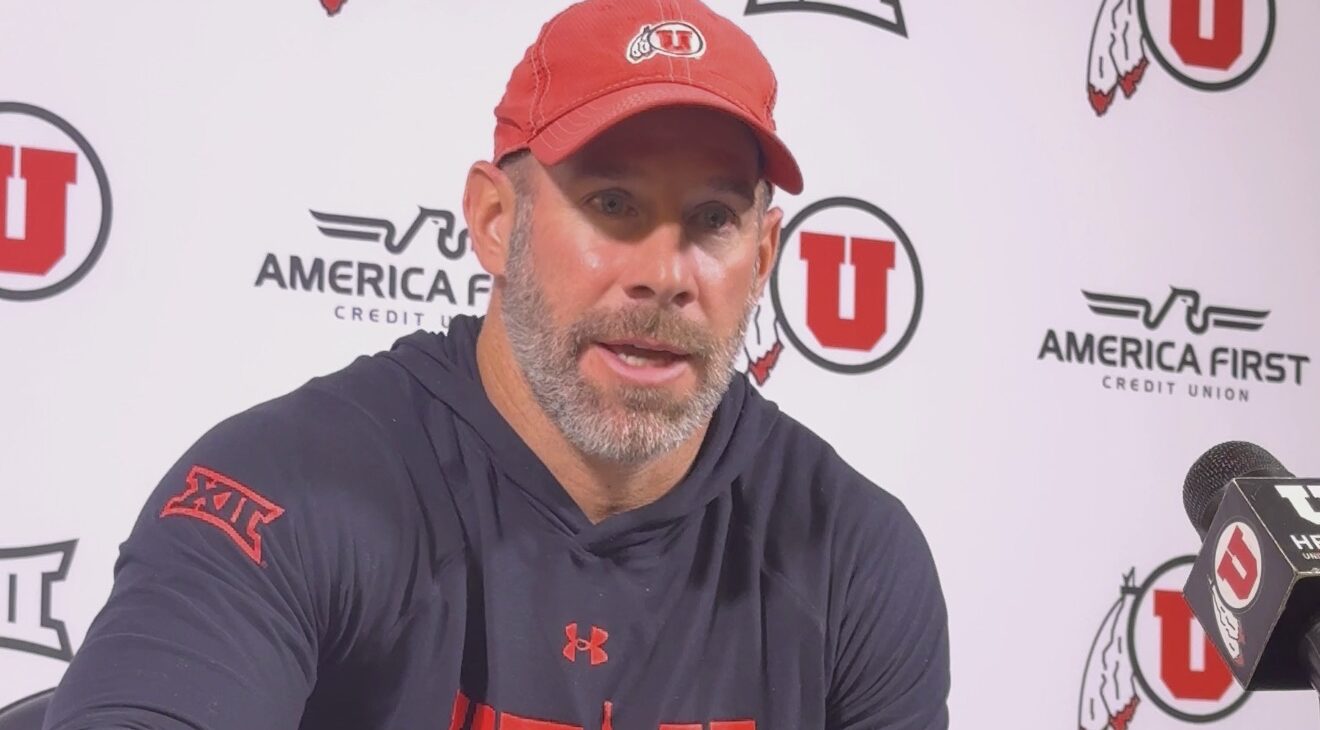
After the game, head coach Gavin Peterson didn’t dodge it, noting that the players on the floor are usually the group that brings energy and urgency.
“The start of the third quarter was bizarre,” Peterson said. “The players we had on the court are usually like, let’s go. And they scored quickly… and then we turned the ball over. We can’t compound those mistakes.”
That compounding effect — score, turnover, score — has become a pattern.
“Now we’re in our thought process like, ‘Oh my gosh, we gotta stop this run,’” Peterson said. “And we’re not focusing on what we need to focus on, which is just play basketball.”
BYU stretched the lead to as many as 21 in the third. In rivalry games, that kind of avalanche is usually fatal.
Delaney Gibb Was the Difference
BYU stretched the lead to as many as 21 in the third quarter, fueled largely by Delaney Gibb. The Cougar guard finished with 37 points, 27 of them coming after halftime. She hit five second-half threes and found rhythm Utah never truly disrupted.
Peterson credited Gibb as one of the best players in the conference and admitted Utah didn’t do enough to break her rhythm.
“Delaney Gibb is one of the best players in the conference, and we didn’t do a good enough job breaking her out of her rhythm,” he said. “When somebody’s feeling it, it’s hard.”
When she banked in a three during the surge, he called it a ‘backbreaker’ — the kind of shot that swings momentum in rivalry games.
Utah’s defensive rotations were late. Closeouts lacked bite. Against a confident scorer, that margin is unforgiving.
Youth Is Real — But Not an Excuse
This team doesn’t have layers of upperclass experience. The rotation leans heavily on underclassmen and players navigating major minutes for the first time in a cutthroat conference. Peterson acknowledged the reality but refused to hide behind it.
“I think it’s one of the best conferences in the country, hands down, from top to bottom,” he said. “Maybe it has something to do with our youth, but I feel like we’ve had enough games and experience under our belt, so I don’t want to use that as an excuse anymore.”
That’s the balance Utah is living in. Development and winning — simultaneously.
“This is the longest you’ve played basketball at such a high level,” Peterson said of freshmen adjusting to the D1 level. “The demands of a Division I athlete is tough… but you can push through this. You can accomplish hard things. This sets the tone for the future.”
Utah shot just 33.3% from the field and 28.6% from three. BYU shot 53.7 percent overall and 45.8 percent from deep. That efficiency gap is massive. Add in 16 turnovers and a lopsided paint battle, and the math becomes hard to overcome.
That’s not entirely on the youth of this team. Peterson and the Utes need to genuinely evaluate and make the adjustments, especially on the defensive side of the floor, to make noise in the final two regular season games.
The Mindset Moving Forward
Peterson pointed to the late response with pride, saying he loved the fight his team showed toward the end of the third and into the fourth. The Utes played through the final buzzer, even when the margin suggested otherwise.
Despite the loss, Utah remains squarely in postseason conversation with opportunities ahead — starting with a road trip to Boulder and the Big 12 Tournament looming.
“Nothing changes from our program’s perspective,” he said. “I expect nothing but their best, their focus… We’re going to try to go 1-0. That’s the standard.”
He even challenged his team with perspective. “How many games you guys want to play? Let’s go. At this point in the season, let’s play our way into the tournament.”
This rivalry loss stings. It should. Utah struggled offensively, allowed 67 percent shooting in the second half, and once again let a third quarter dictate the outcome.
The Bottom Line
Utah lost this game because it lacked urgency, consistency, and the attention to detail necessary in a rivalry game. Sure, the effort was there late in the game, but where was it coming out of halftime? Or in the final minute of the second quarter?
The third quarter remains the dividing line between who this team can be, good and bad. Peterson has to figure out how to get his squad to come out of the locker room with a tenacity that has been rare this season.
Against veteran teams, a three-minute lapse becomes a 15-point hole. In the Big 12, that’s the difference between playing from control and playing from desperation.
But here’s the reality: this roster isn’t built for a one-year window. It’s built for growth. The freshmen are logging heavy minutes. The sophomores are learning how to lead. The seniors are trying to steady the ship in a brutal conference that punishes every mistake. That development comes with turbulence.
Rivalry losses sting. And this one was a particularly frustrating effort as well. Utah must address the third-quarter lapses and how to sustain focus for 40 minutes, the ceiling is still there. The opportunity is still there.