Unloading the notebook: Utah football’s depth is taking shape, but competition continues before opener
Aug 24, 2026, 2:11 PM | Updated: Aug 25, 2026, 10:43 am
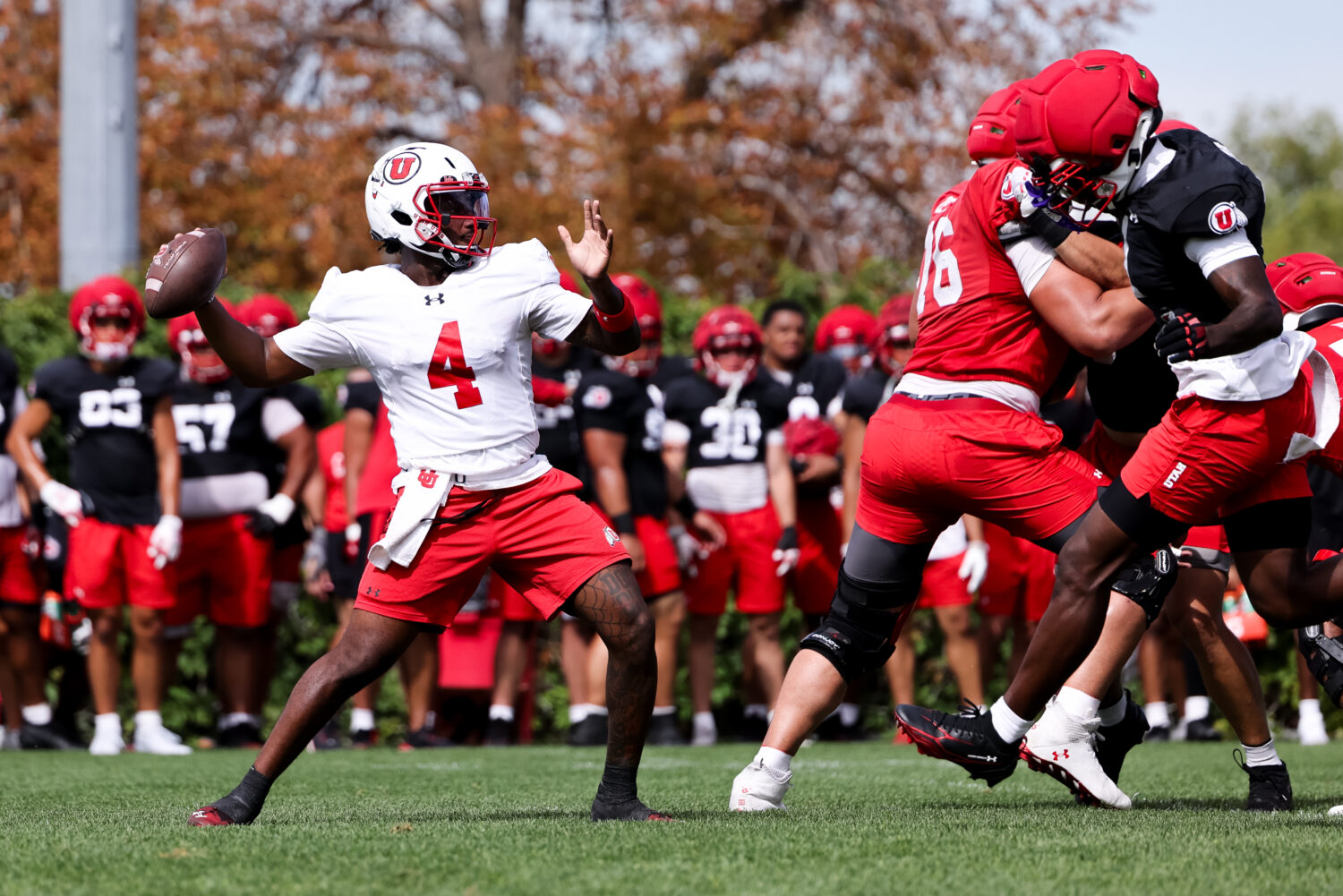
Devon Dampier leads the Utah offense in fall camp. Photo courtesy by Utah athletics.

SALT LAKE CITY — Utah football has moved beyond fall camp and into game preparation, but Monday’s assistant-coach availability made one thing clear: The roster may be settling into place, but several roles are not finished products.
That is especially true along the offensive line, across the defensive front and within a group of offensive skill players that appears deeper than it was during the spring.
The most encouraging development is not that Utah has found an undisputed answer at every position. It hasn’t. It is that the coaching staff increasingly sounds as though it is choosing between viable options rather than searching for someone—anyone—capable of handling a role.
Here is what stood out from Monday’s availability.
Utah’s offensive line competition is about selection
To start, Utah has not finalized its starting offensive line, but Jordan Gross does not sound like a coach frantically searching for five functional players.
“It’s not, ‘Oh crap, who is it going to be?’” Gross said. “It’s like, ‘Dang it, who do I need to pick out of this unit?’”
The Utes entered the offseason without a returning starter, then introduced a new offensive coordinator and position coach. Mixing and matching was inevitable. The concern was whether all that change would prevent the group from developing enough cohesion before the season.
Gross believes Utah has instead developed approximately 10 offensive linemen it can trust.
“There are some guys that have more experience or are better than others, but that depth development has been the bright spot—even more so than our first five,” Gross said. “That second five that we think we could win a game with is what’s really nice for us right now.”
That does not mean all 10 are interchangeable, nor does it eliminate the importance of establishing a starting combination. Communication and chemistry were among the priorities the linemen identified themselves when Gross asked what still needed work.
Kevin McGiven, however, said the offense has maintained good communication despite using multiple combinations.
“There’s trust being developed regardless of who’s in there at what spot,” McGiven said.
Gross specifically mentioned Alex Harrison, Zereoue Williams and Keith Olson as players who have invested years in the program and will receive opportunities. He also praised Solatoa Moea’i for arriving in perhaps the best shape of his Utah career.
“Solatoa Moea’i has done a fantastic job of getting in great shape,” Gross said. “He’s going to have a fantastic year.”
True freshman Kelvin Obot also remains in the equation. His established relationship with Gross has eased the transition, but Obot has remained competitive because of his talent and approach—not merely familiarity with the coach.
“For being a true freshman, it’s impressive how well he’s been able to get himself back in the equation,” Gross said.
Utah still needs to choose its five. The difference is that the decision is beginning to resemble a lineup choice rather than a distress call.
McGiven wants touches to follow talent
One of the most revealing comments from McGiven had nothing to do with a preferred formation or run-pass ratio.
The coordinator wants Utah’s offense to be dictated by its personnel.
“There’s been places where maybe it was a necessity to throw,” McGiven said. “To me, it’s more just centered around your personnel.”
That sounds obvious until a play caller reaches the fourth quarter, looks at the stat sheet and realizes one of his best players has barely touched the ball. McGiven admitted that option-based concepts can sometimes produce that result, even when a running back entered the game plan expecting a significant workload.
“You never want to come out of the game and have playmakers that didn’t get opportunities,” McGiven said.
Utah will track touches and targets throughout games, then adjust its scripting and sequencing when necessary. McGiven specifically said Wayshawn Parker must receive opportunities to carry his share of the offense.
Parker is not the only back the Utes intend to feature. Daniel Bray’s strong spring continued into fall camp, and Mark Atuaia called him a “continual bright spot” for the offense.
McGiven believes Bray can be used in some of the same ways as Parker and in other roles that better fit his own skill set.
The Utah offense is unlikely to revolve around a single prescribed distribution. The more important question is whether McGiven consistently gets the correct players involved before the game forces his hand.
Dampier gives Utah margin for error
McGiven offered the simplest explanation yet for what makes Devon Dampier valuable to an offense.
“You don’t have to be perfect as a play caller because he just kind of makes things right when things break down,” McGiven said.
That is not permission to build a sloppy offense around weekly improvisation. Utah has spent the offseason helping Dampier become more comfortable operating from the pocket, working through progressions and communicating with receivers.
Ryan Gunderson called Dampier’s vision one of his greatest strengths, comparing it to the old quarterback-vision feature in Madden.
“Devon’s got really wide vision,” Gunderson said.
Dampier already possesses adequate arm strength, throws a catchable ball and can punish defenses outside the pocket. The developmental emphasis has been making him more efficient when the initial structure remains intact.
“He’s fantastic throwing the ball outside the pocket,” Gunderson said. “We’ve worked a bunch on throwing it from the pocket, and he’s gotten way better at it.”
McGiven also said Dampier’s leadership and processing have improved. Greater comfort within the offense has allowed the quarterback to become more vocal because he is no longer spending every moment trying to solve his own assignment.
Defensive coordinator Colton Swan has seen that growth from the opposite sideline.
“You might think you have him, but in actuality, you don’t,” Swan said.
Swan described their fall-camp matchup as a chess match, with Utah’s defense testing Dampier through pressure and disguise. The quarterback, according to Swan, handled those challenges well.
Ficklin remains part of the offensive plan
The arrival of Brandon Rose gives Utah another experienced quarterback, but it has not reduced the staff’s interest in using Byrd Ficklin.
“Byrd has the type of athleticism and talent that you’re going to want to find ways to use him, regardless of what that looks like,” McGiven said.
Gunderson delivered a similar message. Utah wants Ficklin to operate within the offense without coaching the improvisational instinct out of him.
“He’s played real reps,” Gunderson said. “He’s got crazy amounts of talent.”
Rose provides a different option. Gunderson praised his maturity, low ego and arm talent, bluntly saying, “He can rip it.”
If Rose is needed, Utah will adjust its offense to his strengths rather than expecting him to imitate Dampier or Ficklin. His presence provides insurance, but Ficklin’s role was never supposed to exist only because Utah lacked another quarterback.
The receiver room has real competition
Braden Pegan remains the standard within Utah’s receiver room.
Chad Bumphis described him as “a true leader in every sense of the word” and said his performance improved during the latter stages of camp. Pegan’s familiarity with the system has helped him establish himself, but his daily level of play has also pulled the rest of the group forward.
Beyond Pegan, McGiven identified Ricky Johnson and Creed Whittemore as two receivers who have meaningfully expanded their roles.
“Creed probably has carved out more of a role than what he even had in the spring,” McGiven said.
Bumphis said Whittemore and Mana Carvalho have taken control of much of the slot work, while Johnson has demonstrated the flexibility to move outside. Carvalho’s health has allowed his open-field ability to emerge more consistently.
“He’s a real ball-in-hand guy,” Bumphis said. “You can just put the ball in his hands and let him go.”
Tobias Merriweather also closed camp well. Bumphis said Saturday’s work in Rice-Eccles Stadium may have been one of Merriweather’s best practices.
The larger takeaway is that Utah is no longer trying to identify one receiver capable of joining Pegan. Bumphis believes the room has legitimate depth, and that has raised the daily cost of a poor practice.
“The guy behind you can do just as much as you can,” Bumphis said. “There’s no bad days.”
Sharrieff Shah has seen the improvement while coaching against the group. In previous seasons, Utah’s defensive backs may have competed to face one or two preferred receivers during practice. Shah said that luxury is gone.
“We all better have good technique,” Shah said, “because all of the receivers pose a very real problem.”
That is a strong endorsement. It will mean considerably more if the depth begins creating explosive plays once the season starts.
Utah’s tight ends are becoming more versatile
Hunter Andrews is healthy after being limited during the spring, and both Wells and McGiven identified him as one of the room’s most improved players.
“Hunter’s full speed,” Wells said. “Hunter looks good playing.”
His field-stretching ability remains the obvious attraction, but Wells said Andrews has also improved as a route runner and perimeter blocker. McGiven went a step further, saying Utah can construct specific concepts around Andrews.
The Rhino position is also expanding. Wells initially viewed the group primarily through its physical responsibilities, but the players have shown more ability in space than expected.
“We’ve even expanded more stuff for those guys,” Wells said.
Kanai Lopes has continued transitioning from linebacker, while Noah Bennee and Will Monney have improved as blockers. Wells described Monney as an intelligent and trusted pass catcher.
The goal is not to ask every tight end to become the same player. It is to create enough overlap that Utah can change formations and assignments without announcing its intentions through substitutions.
Utah’s defensive front should operate through complementary pieces
Inoke Breckterfield does not appear to have one prototype repeated throughout his defensive-end room.
Lance Holtzclaw supplies the twitch and speed to threaten the edge. Ethan Day combines athleticism and physicality. Kash Dillon offers length and physicality, and Paul Fitzgerald has shown more athleticism than Breckterfield initially expected.
Fitzgerald has also impressed with his appetite for contact.
“He loves striking, and he loves sitting there knocking people back,” Breckterfield said.
Day’s transition from the Group of Five level has been seamless.
“When you watch practice and you watch him, you can’t tell that he just came from a Group of Five,” Breckterfield said. “He fits right in.”
PJ Takitaki could carve out a third-down pass-rush role while contributing on special teams. Alex Cloward provides a dependable option who understands the defense, even if he does not possess the same twitch as some of the others.
Holtzclaw remains the headliner, but Breckterfield is not burdening him with a statistical mandate.
“You don’t have to do anything extraordinary,” Breckterfield said. “Just do the ordinary stuff better than anybody else.”
Inside, Luther Elliss identified Jireh Moe and Karson Kaufusi as Utah’s most consistent defensive tackles. Pupu Sepulona and Kaufusi benefit from last season’s playing experience.
One player Elliss singled out as a big positive was Dilan Battle, who he said has made substantial progress since the spring.
Elliss rotates his starters based on the previous practice because he does not want anyone becoming comfortable.
Utah has talent across the defensive front. The next step is turning complementary skill sets into a rotation that remains productive beyond its first wave.
Four linebackers have earned consideration
Swan identified Johnathan Hall, Trey Reynolds, Elijah Elliss and Cyrus Polu as the four linebackers Utah must find ways to utilize.
Hall possesses the most experience and has expanded his skill set during the final weeks of camp. Reynolds remains the room’s reliable presence. Elliss and Polu are the young talents who have made the rotation more complicated—in a good way.
“They’re phenomenal linebackers,” Swan said.
That does not guarantee equal playing time. It does suggest Utah could use different combinations based on opponent, personnel and situation rather than expecting two linebackers to absorb every meaningful snap.
The defense’s larger emphasis remains restoring its run-defense standard. Swan acknowledged that Utah’s performance late last season fell below what the program expects.
The Utes have made correcting those problems a concentrated focus throughout the offseason, working to ensure players understand how opponents created vulnerabilities and how each defender fits into the solution.
“If we can stop them in practice running the ball,” Swan said, “then we’ll feel comfortable that we can do it against anybody.”
Secondary versatility is becoming a defensive tool
Utah’s flexibility in the secondary is not merely depth-chart trivia. It could directly influence Swan’s ability to disguise coverage and pressure.
Shah used Rock Caldwell as the clearest example.
“He’s been in the safety room, he’s sat with me as a nickel, and I recruited him as a corner,” Shah said.
Players who can “speak multiple languages” in the secondary can remain on the field longer while allowing Utah to change its presentation without substituting.
Elijah Reed also gives the staff an experienced corner who has already played meaningful football.
“We’ve got a guy that’s been in the fire,” Swan said.
Among the freshmen, Dillon Waters has impressed Shah with his recognition and anticipation. Major Henschen’s boxing background has translated into strong hands, balance and comfort fighting through contact.
Both still need to establish value on special teams before earning larger roles, but Shah is pleased with their development.
Special teams are stabilizing
Shah feels better about Utah’s kicking operation than he did three weeks ago.
Morgan Scalley has created intentionally chaotic practice situations around the specialists, including teammates yelling, water being sprayed and Scalley running near the operation before the kick.
It sounds a little unhinged. That is the point. Utah wants its specialists to develop a pre-kick routine sturdy enough to survive external noise, pressure and a previous miss.
“If you can kick and make it under those circumstances, you develop a hardened exterior,” Shah said.
The return game appears more defined. Daniel Bray is the initial favorite on kickoffs, with Larry Simmons and Ricky Johnson also involved.
At punt returner, Shah offered his strongest statement of the afternoon.
“Mana Carvalho stands to be probably one of the top in the conference,” Shah said.
Creed Whittemore provides another option, but Carvalho’s combination of vision and open-field creativity makes him one of the more intriguing players to watch when Utah receives its first punt.
The Bottom Line
Monday’s availability did not produce many definitive depth-chart declarations. It did, however, reveal a roster with more credible options than Utah appeared to have during the spring.
The offensive line remains unsettled, but Gross believes the Utes have developed a second unit capable of winning. Utah’s receivers and tight ends have created more flexibility for McGiven, while Dampier’s progress gives the offense a quarterback capable of rescuing imperfect situations.
Defensively, Utah is building rotations from complementary players rather than asking one star to cover every weakness. The linebackers are deeper, the secondary is versatile and the defensive front has options.
There are still unresolved questions. Utah must establish its best offensive-line combination, prove its receiver depth translates into production, restore its run-defense standard and stabilize the kicking game under actual pressure.
But with the opener approaching, Utah’s questions increasingly concern how to deploy its personnel—not whether it has enough of it.