Same Physical DNA, More Answers: Inside Morgan Scalley’s Vision for Utah’s Offense
Jan 7, 2026, 8:30 AM | Updated: 8:54 am

Dec 31, 2025; Las Vegas, NV, USA; Utah Utes interim coach Morgan Scalley watches from the sidelines against the Nebraska Cornhuskers in the first half during the SRS Distribution Las Vegas Bowl at Allegiant Stadium. Mandatory Credit: Kirby Lee-Imagn Images

SALT LAKE CITY— For weeks, and much longer than that really, the speculation around Morgan Scalley’s vision for the offense followed a familiar path: Is Utah finally going to throw the ball more? Is the offense modernizing? Is the old identity changing?
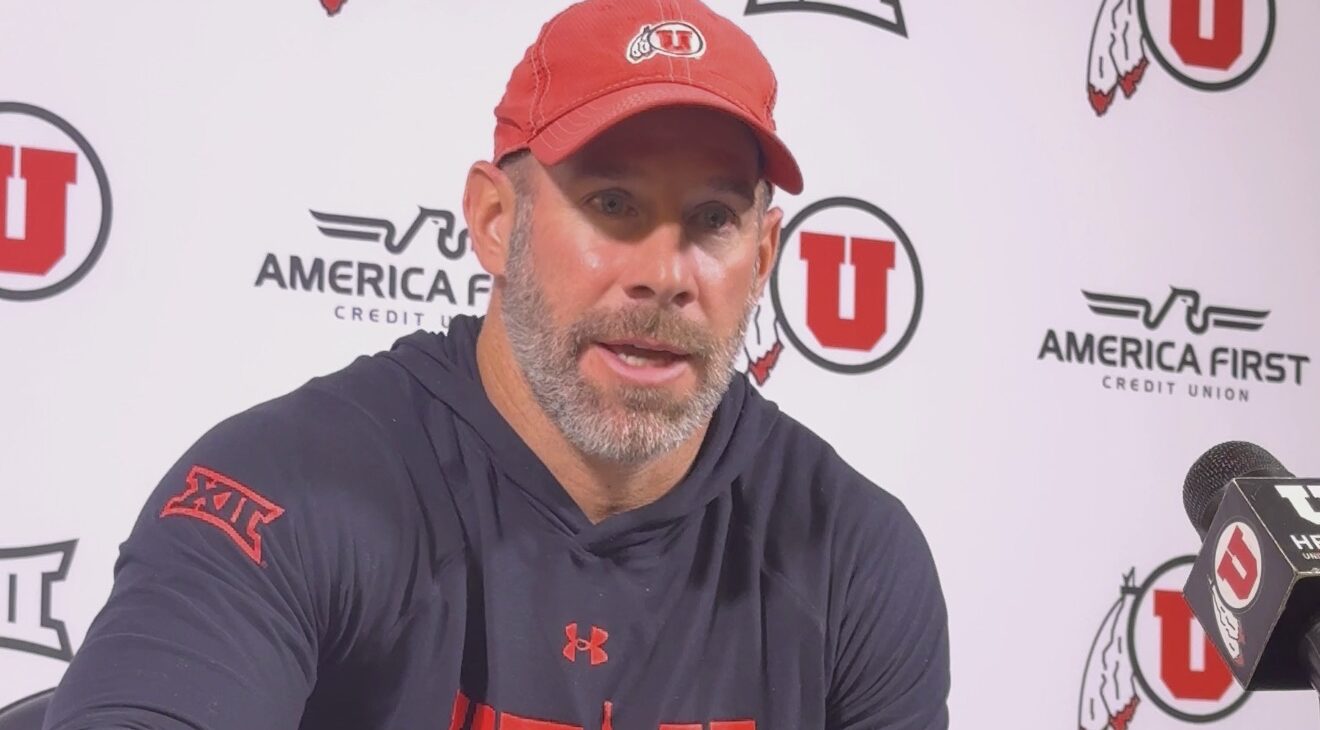
Scalley finally was able to speak to what his culture and vision actually is on offense — “No. 1, is physicality — you win championships at the offensive and defensive line, period, end of story,” Scalley said. “I also believe you have to be innovative, you have to be creative.”
That framing matters. Because this isn’t Utah abandoning what it’s spent the last twenty years building. But it’s a refusing to let physical dominance become predictable. It’s embracing adaptability, creativity, and versatility.
Morgan Scalley’s Vision: Physical First — Innovation Second
“No. 1, is physicality — you win championships at the offensive and defensive line, period, end of story,” Scalley said. “I also believe you have to be innovative, you have to be creative.”
Scalley never talked about pass attempts, tempo, or scheme labels. He talked about leverage, pressure, and problems — the kind defenses can’t solve with one adjustment.
“You have to be physical and you have to be innovative,” he said. “You always have to be on the cutting edge.”
That combination — violence plus evolution — is the throughline of his offensive philosophy. He talked about the need to constantly be learning, to have the mindset of never knowing enough.
As he evaluated options to hire an offensive coordinator, one name stuck out and it was the track record of the quarterback position that played a big role.
Empowering the quarterback spot
The hire of Kevin McGiven wasn’t about chasing a passing identity. It was about finding an offense that empowered the quarterback, regardless of strengths.
McGiven’s offenses have never been rigid. They’ve been adaptive — built around what the quarterback can do, not what the system demands.
His offenses are rooted in spread principles with varied personnel groupings. He frequently deploys 11-personnel (3-WR, 1-TE, 1-RB) to create spread passing looks while retaining a tight end for versatility.
The 𝐬𝐭𝐚𝐧𝐝𝐚𝐫𝐝 lives here. So does 𝐀 𝐔𝐓𝐀𝐇 𝐌𝐀𝐍! 🔴⚫️#GoUtes | @RSNBUtes pic.twitter.com/fSb91S5F5h
— Utah Football (@Utah_Football) January 6, 2026
One of McGiven’s greatest assets is tailoring his scheme to the quarterback. Pocket passer? He’s coordinated nationally elite passing offenses. Dual-threat? He’s built run-heavy attacks that still punish coverage. Limited resources? He’s leaned on sequencing, spacing, and decision-making.
He has succeeded with pure pocket passers Josh Love’s shotgun spread passing for ~3,900 yards in 2019. He helped dual-threat QBs such as Chuckie Keeton and Bryson Barnes each logging 600–700+ rush yards in a season.
When coaching a pocket QB, McGiven leans on quick reads, vertical concepts, and heavy passing volume. With a mobile QB, he will integrate designed QB runs, zone-read options, and roll-out pass designs.
This adaptability has allowed McGiven’s units to remain productive whether the signal-caller is a 6’6” pocket gunner, a smaller dual-threat scrambler, or anything in between.
“Issues at Levels” Isn’t Coach Talk
“If you watch and study the film — at least, if you know football — you’ll see the issues his offense can present,” Scalley said. “He creates issues at levels in football.”
McGiven’s offenses consistently stress defenses in layered ways:
-
Linebackers choosing between run fit and underneath coverage
-
Safeties forced to tip their hand pre-snap
-
Edge defenders frozen by read elements and play-action
- Coverage conflicts created by pass concepts and route combinations
One McGiven-coordinated offense finished an entire regular season with six total turnovers. That’s not happenstance. That’s an offense built to protect the quarterback — and a quarterback trained to protect the offense.
Same Physical DNA, More Answers
Scalley isn’t chasing a prettier offense. He’s chasing a more dangerous one. The foundation remains unchanged: control the line of scrimmage, punish mistakes, and dictate terms physically. What changes is how those principles are deployed.
If Utah keeps its physical edge and pairs it with an offense that consistently “creates issues at levels,” that’s where offenses flourish. McGiven’s track record shows offenses that can live in all three worlds — pass-heavy, run-heavy, or balanced — without sacrificing efficiency.
“He’s really good at what he does,” Scalley said. “He’s efficient at what he does.”
Utah has always valued toughness, intelligence, and competitiveness. McGiven’s best offenses didn’t require superheroes. They required decisiveness, ball security, and a quarterback willing to punish defenses with legs and arm, whichever was needed.
The Bottom Line
Morgan Scalley’s vision for Utah’s offense isn’t about chasing trends or padding passing stats — it’s about staying true to Utah’s physical DNA while adding layers that make that physicality harder to defend.
The emphasis remains on winning at the line of scrimmage, but not in a static, predictable way. Instead, Scalley wants an offense that forces defenses to declare, hesitate, and ultimately crack.
With Kevin McGiven, Utah gets a system that empowers the quarterback, adapts to personnel, and creates problems defenses can’t solve with one answer.