The NBA salary cap isn’t equal, and it shapes everything the Jazz do
Jul 24, 2026, 3:59 PM
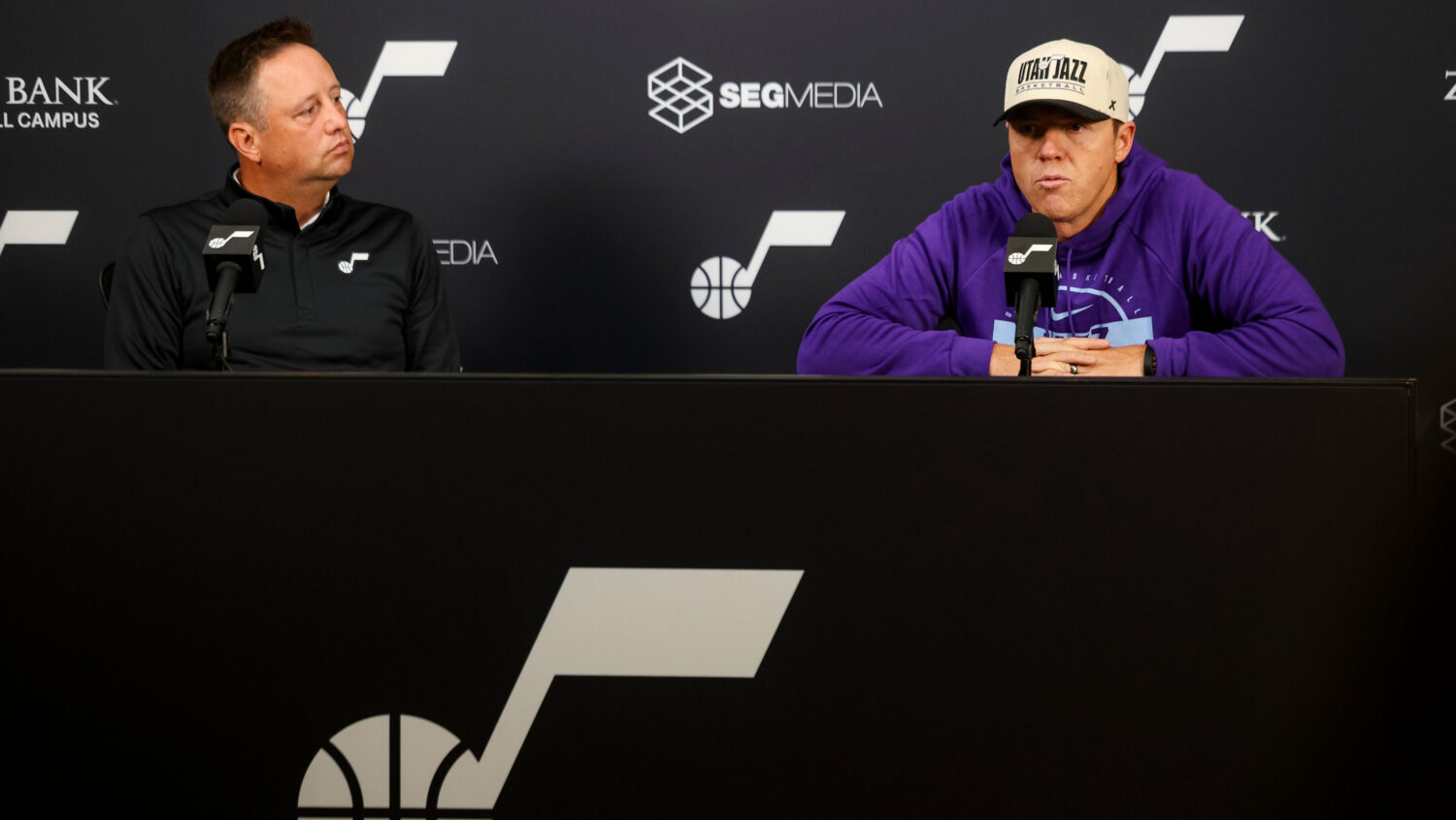
Austin Ainge, president of basketball operations, left, and Ryan Smith, chairman and CEO of Smith Entertainment Group and governor of the Utah Jazz, right, speak to media during the Utah Jazz media day at the Zions Bank Basketball Campus in Salt Lake City on Monday, Sept. 29, 2025. (Photo courtesy of Rio Giancarlo, Deseret News)
(Photo courtesy of Rio Giancarlo, Deseret News)

SALT LAKE CITY — The NBA salary cap is one of the most complex in professional sports, and its effects reach further than what’s put on paper.
The league does its best to put all 30 teams on even ground, but market size continues to leave its mark on team building.
There are five financial thresholds that apply to every franchise: the minimum team salary, the salary cap, the luxury tax line, the first apron, and the second apron. Teams that exceed the luxury tax line pay tax penalties, while those in the first and second aprons face increasingly restrictive roster-building limitations.
The thresholds change as league revenue increases, but the NBA’s goal of competitive balance stands strong.
That said, if every team operates under the same cap, why don’t they all spend the same way?
The Utah Jazz’s active roster salary table.
Not pictured are Blake Hinson, Tamar Bates, and Trey Alexander on two-way deals. pic.twitter.com/bysYVM5LPv
— Chandler Holt (@CHoltSports) July 24, 2026
Why not all cap space is created equal
Two factors play a major role in answering this question: owner behavior and market size.
To better understand how the market a team competes in affects team-building, you must know where the money comes from. The NBA is a business made up of 30 independently owned franchises. Revenue comes from both league-wide and local sources.
League-wide revenue comes in the form of media rights, NBA sponsorships, licensing, and more. That revenue is generally split equally.
Local revenue is ticket sales (especially premium seating and suites), parking, arena advertising, local media rights, and more. These streams still count toward “basketball related income,” a phrase tossed around often in the league’s collective bargaining agreement. Under the revenue-sharing program, even local revenue is partially shared.
One increasingly valuable source of revenue for owners is mixed-use development surrounding an arena. The Warriors have done it, the Clippers did it in their own way with the Intuit Dome, and Jazz owner Ryan Smith has shared a similar vision with downtown Salt Lake City.
Downtown Salt Lake City is the heart of Utah. Our efforts are not about an arena, it’s about revitalizing a downtown that desperately needs investment. Imagine a downtown experience like this with the NBA / NHL at its core. pic.twitter.com/w2Qzxf17gs
— Ryan Smith (@RyanQualtrics) February 27, 2024
Those developments capitalize on the traffic generated by NBA games while avoiding the basketball-related tag. It is then on the owners to decide whether to reinvest that money back into the franchise. Which, in most cases, comes across as a willingness to pay the luxury tax and/or enter the aprons.
NBA team owner behavior
Owner behavior has become a larger talking point recently as Tom Dundon took over as the governor of the Portland Trail Blazers. That situation serves as a perfect example of the low end of the spectrum.
Already operating in one of the league’s smaller markets, Portland has made several moves that reduced payroll under Dundon’s ownership. The Trail Blazers currently sit below the luxury tax line, and recent decisions suggest the organization is not looking to enter it in the near future.
On the other hand, numerous teams in recent history were willing to swallow the penalties and pay the extra money to either build or hold on to a contending team — Golden State, Phoenix, Boston, the list goes on. In most of those cases, they quickly made moves to duck under the thresholds when they felt the time was right. can’t stay in hot water for too long.
Piecing the puzzle together, market size doesn’t directly impact how teams maneuver the salary cap; it creates different business opportunities, while ownership determines how aggressively to pursue them and how willing it is to spend.
This intersection of market reality, ownership, and CBA rules sets up a pivotal juncture for franchises at every stage of the competitive cycle.
it all adds up 💯#TakeNote | @MarkkanenLauri pic.twitter.com/EVee75NbC8
— Utah Jazz (@utahjazz) July 23, 2026
The team-building reality for the Utah Jazz
Utah will never be the free agent destination of Los Angeles or New York, but they have something that a lot of teams don’t: a local owner who is all in on selling the state through sports and all in on bringing a championship to Utah.
As the Jazz enter a new competitive era, we will see how roster construction plays out. Especially with potentially expensive extensions for Keyonte George, Ace Bailey, and Darryn Peterson looming in the years ahead.
Whether the Jazz choose to pay into the luxury tax or the aprons in the coming years won’t simply be a basketball decision. It’ll be a business decision, too.
The salary cap is the same in every city, but the business behind each franchise isn’t.