How Utah basketball’s 2026–27 roster actually fits
May 1, 2026, 11:54 AM | Updated: 2:12 pm

Dec 6, 2025; Salt Lake City, Utah, USA; Utah Utes head coach Alex Jensen watches play against the California Baptist Lancers during the first half at Jon M. Huntsman Center. Mandatory Credit: Rob Gray-Imagn Images

SALT LAKE CITY — For the first time in a while, Utah basketball isn’t walking into an offseason searching for answers. It’s come into the offseason with a plan, and to this point, the staff has executed that plan.
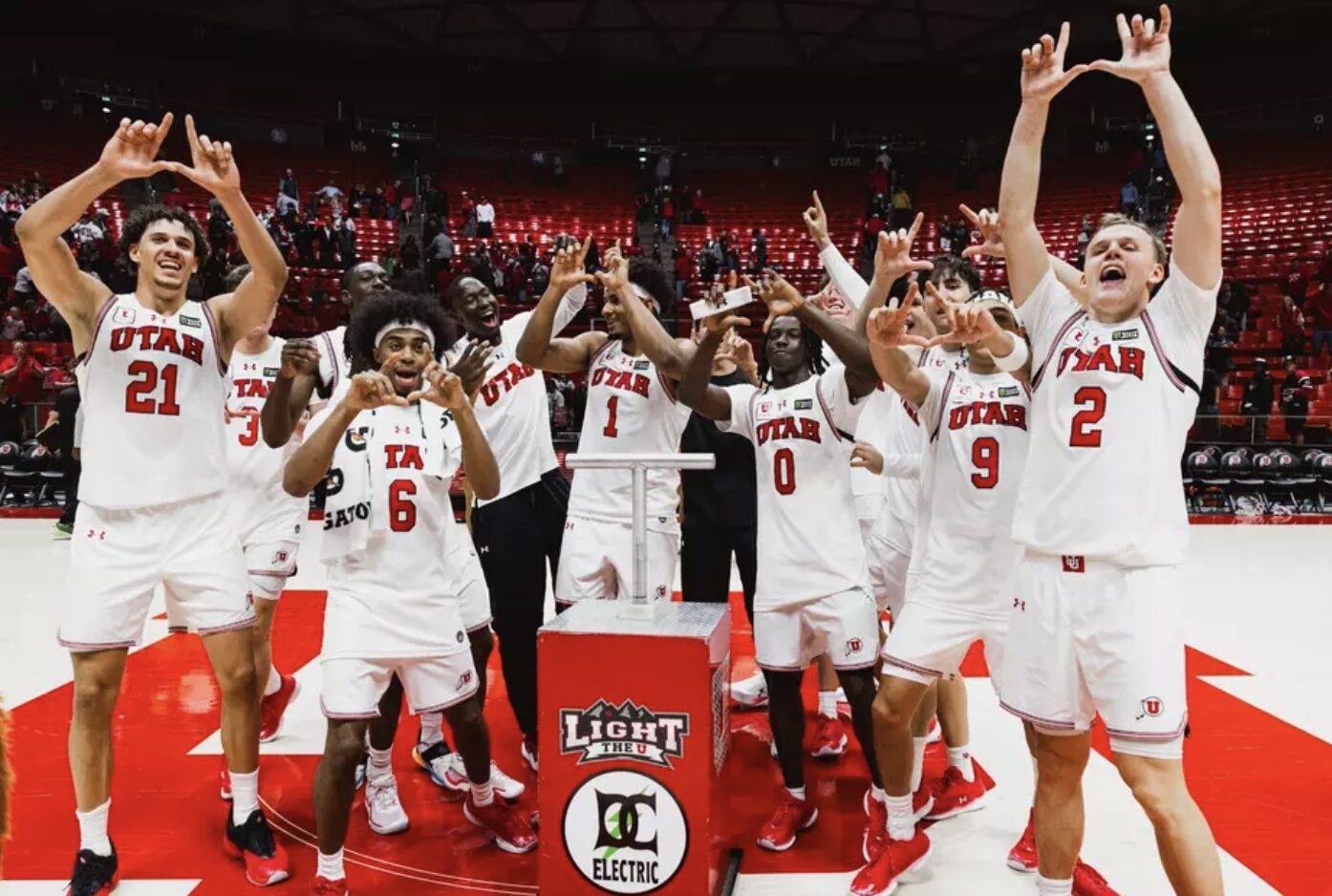
The roster has shape. The roles are defined. And as this group begins to come together for offseason workouts, the focus shifts from building on paper to building on the floor — where chemistry, execution, and identity will ultimately decide what this team becomes.
Last year’s group lacked identity. This one has a blueprint — built around a lead guard, versatile wings, and a frontcourt that can toggle between physicality and spacing.
But the real question isn’t just who’s on the roster. It’s what they’re supposed to do. Here’s how it breaks down, position by position — and what it tells us about the system Alex Jensen is trying to build.
Point Guard
Noam Yaacov, TJ Burch, Styles Clemmons
Everything starts here. Noam Yaacov is the centerpiece of the offense. Utah lacked a true initiator last season, and Yaacov fills that void as a pick-and-roll maestro and primary decision-maker. His three-level scoring ability will open a lot of the floor for the offense, while his playmaking ability will lead to capitalizing on that.
The addition of TJ Burch has only looked better as it’s aged. He complements Yaacov as the opposite archetype — a defensive disruptor. His value isn’t just on-ball defense; it’s turning stops into transition opportunities. He’s could be a bit of a tone-setter on that end of the floor.
The competition between these two in practice will be heated, and that could be key in ensuring the both of them translate to the Big 12.
Styles Clemmons is more long-term. Athletic, active, but not yet a rotation piece. Lots to learn, but he should develop a lot behind the other two. If there is a route to playing time, it’s going to be through defensive effort.
Shooting Guard
Lucas Langarita, Taison Chatman, David Katoa
This is where Utah’s offensive ceiling could be determined. Without significant production to evaluate, this group is more about projection.
Taison Chatman’s shooting is the cleanest fit with what Utah seems to be building. He does not need to be an on-ball guy to impact the game, and that’s critical next to Yaacov. Utah’s offense will be built around point guard creation and spacing is critical to that, and Chatman’s ability to punish help defenders from behind the 3-point line is central to that.
A wildcard of sorts is the returning guard, Lucas Langarita. This past season did not go as planned for him, and there’s context to consider as to why. However, the evaluation and projection is still that he can be an offensive force. With Yaacov as the primary creator, Langarita doesn’t need to be a distributor. Instead, he can refocus his game on scoring and secondary playmaking.
David Katoa fits the “older freshman” profile — size, maturity, but mostly just depth right now. Similarly to Clemmons, the path to year one playing time for Katoa is going to be on the defensive end of the floor.
Small Forward
Jackson Holcombe
There’s no real debate here — this is Jackson Holcombe’s role, and it’s one of the most important on the team. He’s not the scorer. He’s not the engine. He’s everything else.
Holcombe is a connector — a player who keeps possessions alive, moves the ball, rebounds, and defends multiple positions. His ability to impact the game without dominating the ball makes him essential in a system built around a primary creator.
The concern is obvious: shooting. He hit just 16.2% from three last season. That matters because it affects spacing. But Utah doesn’t need him to be a high-volume shooter — just credible enough to keep defenses honest.
This is a flexible spot for Utah roster wise, so while Holcombe is the only one listed, others will contribute here as well.
Forward
Alec Anigbata, Zati Loubaki, Jaxon Johnson
This is where Utah is trying to modernize, adding a genuine floor spacer in the frontcourt.
Alec Anigbata is the key piece. At his best, the 6-foot-9-ish, 210-pound wing forward opens the floor, and attacks space— something Utah wanted out of Keanu Dawes. His ability to space the floor as a 40% 3-point shooter changes how defenses will defend the floor. Anigbata will need to prove he’s the same sort of rebounder as Dawes was, but offensive game fits what Jensen wants from the position.
Zati Loubaki offers a similar concept off the bench — a bigger, athletic forward who can shoot and keep spacing intact. At 6-foot-9, 230 pounds, Loubaki converted 42.5% (17-of-40) from deep this season at Trinity Valley. The question is translation from the JUCO level, but at the very least, Loubaki’s effort level should translate.
Together, Utah seems to have two solid options here, but that’s not all they have.
Jaxon Johnson is a promising piece but should be viewed as more developmental. There is a lot of optimism regarding what he can become. The tools are there, but where his game is post-church mission is the determining factor. At 6-foot-9, Johnson will be another forward that adds size and shooting to stretch the floor. Minutes will probably be sporadic but it’s all about development.
Center
Babacar Faye, Fynn Schott, Malek Gomma
This group is largely being dismissed, but these three give Utah a level of depth it did not have this past season.
Even though Babacar Faye did not see action, Jensen is returning a player they consider a starter-level player, still, Faye is a bit of a mystery. The 6-foot-9, 230-pounder possesses a 7’1” wingspan and an 8’11” standing reach, which is the sort of length Utah needed in the paint. He’s proven productive around the rim and has flashed some potential deep ball shooting (5-of-13 in 10 games). The obvious question is his health, and assuming he’s healthy, he seems to be the top option.
Fynn Schott possesses a big, strong frame at 6-foot-9, 235 pounds. His strongest quality is how he attacks the glass with tenacity. There is some promising offensive feel and talent that needs to be developed, but he has a solid outlook primarily due to his motor. Schott seems like a capable option off the bench, who can develop into a starter level player in due time.
Lastly, Malek Gomma’s 6-foot-8, 245-pound build solidifies the floor of the big man spot. He’s another tough interior presence, who can be a rim threat in the pick-and-roll, but mostly, he adds ruggedness that Utah wants embody.
Between the two frontcourt spots, the depth is improved compared to this past season.
The Bottom Line
For the first time in a while, there isn’t a lot of guessing at what Utah wants to be.
There’s a clear structure here — a roster built around a true lead guard, surrounded by shooting, versatility on the wing, and multiple frontcourt options that allow Jensen to toggle between spacing and physicality. That alone is a significant step forward from a year ago, when roles felt undefined and the identity never fully materialized.
But role clarity doesn’t guarantee success.
This roster still leans heavily on projection. The shooting on the perimeter has to hold up under pressure. And the frontcourt — while deeper — still has to establish a true anchor and consistent rotation. Those aren’t minor questions; they’re the ones that separate middle-of-the-pack teams from real contenders.
So yes, Utah is better constructed. More modern. More intentional.
Now comes the next phase — getting this group on the floor together, building chemistry, and seeing how all these pieces actually function once the work begins.