Instant Takeaways: Far From Pretty, Utah Basketball Survives Cal Baptist
Dec 6, 2025, 7:40 PM | Updated: Dec 8, 2025, 9:46 am

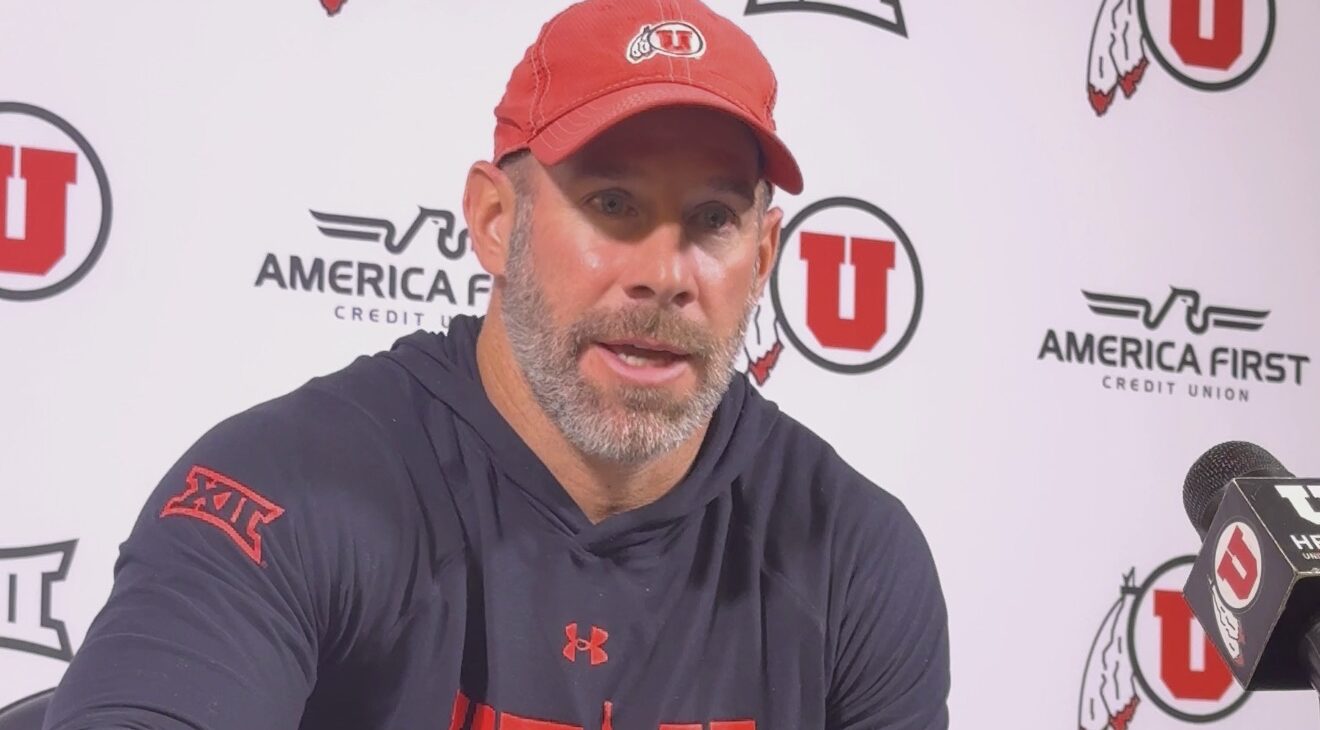
Dec 6, 2025; Salt Lake City, Utah, USA; Utah Utes head coach Alex Jensen watches play against the California Baptist Lancers during the first half at Jon M. Huntsman Center. Mandatory Credit: Rob Gray-Imagn Images

SALT LAKE CITY— Utah didn’t beat Cal Baptist because it cleaned up its flaws — it beat Cal Baptist because Terrence Brown, Don McHenry, and one of the most efficient offensive nights of the season refused to let a rebounding meltdown turn into an embarrassment.
Coach Alex Jensen needed takeover performances from Terrence Brown and Don McHenry, the Utes survived a night where they surrendered 20 offensive rebounds and 31 second-chance points, grinding out a 91–85 win that felt more like a warning than a breakthrough.
Final from the @HuntsmanCenter! pic.twitter.com/voVd52M6Ku
— Utah Basketball (@UtahMBB) December 7, 2025
Here are the takeaways from today’s game…
Utah won because its guards produced elite efficiency
This was not a night where the scoring was evenly distributed or the offense flowed symmetrically. It was a night where Utah survived because Terrence Brown and Don McHenry were, possession-for-possession, dramatically more efficient than anyone Cal Baptist could throw at them.
The metrics make that crystal clear.
Terrence Brown
-
27 points on 9-of-16 shooting
-
136 offensive rating — best among Utah’s starters and a top-tier number for any high-usage guard
-
4 steals, three of which created immediate transition points
-
His on-floor efficiency exceeded Utah’s already blistering 1.47 PPP second-half average during multiple key stretches
Brown wasn’t just productive — he tilted the game. His fingerprints were all over momentum swings:
-
3 of Utah’s 8 steals
-
Five scoring plays in the first six minutes, establishing pace and pressure
-
A perfect 6-for-6 at the line in the final 23 seconds, to close out the game
Whenever Cal Baptist made a push, Brown answered — either by scoring, forcing a turnover, or stabilizing the possession.
Don McHenry
-
21 points, including 7-of-8 at the line
-
Utah averaged 1.22 PPP when McHenry was the finishing action of a possession — via jumper, drive, or trip to the free-throw line.
Where Brown dictated tempo, McHenry rescued possessions. Utah’s halfcourt offense bogged down as the game tightened, but McHenry’s shot creation — the floaters, the step-backs, the late-clock improvisation — kept the Utes from stacking empty trips. In a game where Cal Baptist’s offensive rebounds kept giving them additional cracks at scoring, Utah needed every one of McHenry’s high-efficiency makes.
And here’s the part that underscores the dependency on them: Utah did not have a single stretch of halfcourt efficiency above 1.05 PPP without Brown or McHenry on the floor.
That’s not speculation — it’s confirmed by the possession chart and on/off sequences. When either guard sat, Utah’s spacing shrank, the ball stopped moving, and the offense became overly reliant on secondary players who aren’t yet consistent creators.
On a night where the frontcourt struggled with rebounding and rim protection, Utah needed its stars to be stars. Brown and McHenry were exactly that — and that’s why Utah escaped.
Utah’s offensive numbers were strong — but the defense gave almost everything back
Make no mistake: offensively, Utah looked like a fairly solid team. This wasn’t just shot-making — it was sustained efficiency over 40 minutes.
Utah shot 49.1% from the field and 40% from three, but the more telling stat was how they generated those looks: 14 assists on 27 makes, consistent paint touches, and relentless pressure that forced Cal Baptist into 23 fouls.
The Utes lived at the line, hitting 29-of-37 free throws (78%), a season-high in both attempts and makes. The possession data reinforces it even more.
Utah scored 91 points on just 68 possessions, good for a blistering 1.34 points per possession — a benchmark typically associated with top-20 offenses nationally. And when they came out of the locker room, they reached an even higher gear: Utah posted 1.47 PPP in the second half, their most efficient half of the year and a level of scoring that buries most opponents before the under-8 timeout.
Any time a team posts over 1.30 PPP, it should win comfortably.
But…
The defensive numbers don’t match that profile. Utah allowed Cal Baptist to score 1.23 PPP, which, for context, is the equivalent of playing against a top-10 offense. The breakdown shows where it all leaked:
-
48 points allowed in the paint — Cal Baptist repeatedly got downhill, finishing at the rim or through broken rotations.
-
31 second-chance points — a staggering figure for any high-major team, let alone one with postseason ambitions.
-
Utah surrendered 20 offensive rebounds, most of them to a frontcourt that was longer but not more athletic.
-
Even as CBU opened the half missing shots, Utah let them find rhythm; the Lancers still shot 44% in the second half, buoyed almost entirely by extra possessions.
The Utes won a shootout on their home floor. That works in December, when talent can outscore mistakes. But starting next month, when the schedule tightens and opponents weaponize every weakness, a statistical profile this lopsided — elite offense, leaky defense, catastrophic rebounding — becomes a ceiling, not a foundation.
The defensive rebounding wasn’t just bad — it was statistically catastrophic
The number of the night wasn’t a shooting stat, a scoring run, or even a player line.
It was the rebounding deficit — and it was extreme.
23 offensive rebounds allowed.
31 second-chance points allowed.
Both come straight from the official stat tables. For perspective, most high-major teams surrender 10–12 second-chance points in an entire game. Utah gave up nearly triple that.
And it wasn’t just the total — it was the pattern. Cal Baptist grabbed 23 offensive boards, and the possession chart shows three separate sequences where the Lancers secured three consecutive offensive rebounds before scoring. Utah didn’t lose 50–50 plays; it lost entire possessions.
-
Utah defensive rebounding percentage: 55.6%
-
National average: ~72%
-
Utah performed 17% below baseline, the equivalent of spotting the opponent 12–15 free possessions.
And the problem sharpened after halftime. Utah allowed 17 second-chance points in the second half alone, meaning nearly every time CBU hit the offensive glass, they scored. The Lancers posted an eye-popping 1.38 points per possession after the break — fueled almost entirely by putbacks, tip-outs, and scramble threes.
Utah has now shown this weakness in multiple games, but this was the clearest statistical indictment yet. On a night when the Utes controlled nearly every other phase of the game, offensive rebounding was the only reason Cal Baptist stayed within striking distance.
And it’s the one flaw that, if left unsolved, carries real consequences when the competition stiffens.
Alex Jensen trying to draw more out of Keanu Dawes
Dawes’ 10 points don’t jump off the page, but his advanced line does:
-
7 assists, a career high
-
6 rebounds
-
Only 1 turnover
-
+9 plus/minus, tied for best among starters
-
Utah scored on 17 of 23 possessions where Dawes touched the ball twice — a staggering efficiency indicator
What doesn’t show up in the box score is the intentionality behind it.
Coach Jensen kept pushing to get Dawes into quality touches and featured situations — not just as a scorer, but as an initiator and advantage creator. Perhaps the most telling dynamic of the night, was the fact that Jensen consistently called out Dawes throughout the game for passing up good shot opportunities.
A steal by @keanu_28 leads to the easy transition SLAM from @terrencetbrown #GoUtes pic.twitter.com/JlBjwbXsI5
— Utah Basketball (@UtahMBB) December 7, 2025
Utah repeatedly ran early-offense drag actions through him, stationed him as the decision-maker on the slot side, and used him as the pressure-release valve when Cal Baptist tried to flatten out Utah’s guards.
The on/off data reinforces why the staff kept returning to him. When Dawes sits, Utah’s lineups lose structural integrity: assist rates drop, spacing flattens, and the offense becomes overly dependent on isolation creation. When he’s involved in multiple actions within a possession, Utah’s efficiency spikes, their turnover rate drops, and shooters actually get clean looks inside rhythm.
Put simply: Dawes isn’t a complementary piece. He’s the connective tissue that makes Utah’s offense function. More than that though tonight, it seemed Jensen was trying to get him to act like a focal point and Dawes has to start believing that is the case.
Dawes has so much potential, he can become a significant difference maker but he’s got to start acting like one — and Jensen coached the game like he’s trying to get that out of him.
Utah’s bench wasn’t flashy, but it changed the math of the game
Jakhi Howard
-
Only 2 points, but an 18% offensive rebounding rate
-
Generated the extra possession that set up Brown’s critical second-half 3
-
Provided Utah’s most active weak-side pursuit on both ends
Howard’s box score undersells how essential he was to Utah’s effort. With Traore out, Utah needed someone to absorb the “dirty-work minutes” — tracking long rebounds, contesting putbacks, sprinting into passing lanes, and keeping Utah from getting punished in transition defense. Howard did all of it.
The possession he extended that led to Brown’s momentum-shifting three was a perfect example: nothing about the play was drawn up for him, yet his activity turned a broken possession into points. Utah needed energy in a game where the margins were dictated by effort, and Howard supplied it every time he stepped on the floor.
Obomate Abbey
-
7 points, 3 steals, and the highest free-throw rate of any Utah player
-
Team-best +8 in first-half minutes
-
His ability to turn live-ball rebounds into immediate fouls shifted momentum mid-half
Abbey’s impact was immediate and unmistakable. Every time the game tilted toward chaos, he inserted force and tempo — jumping passing lanes, initiating transition, and pressuring Cal Baptist’s guards into mistakes. His free-throw rate reflected how aggressively he attacked seams, something Utah lacked whenever the offense stalled.
James Okonkwo
-
7 points, 5 rebounds, including three high-leverage offensive boards in the second half
-
Played a central role in Utah’s second-half free-throw surge
-
His putback jumper with 2:39 left increased Utah’s win probability by nearly 8%
WE SEE YOU 3⃣2⃣ @kingjmo_32 comes up clutch with the putback dunk!!#GoUtes pic.twitter.com/veCNNxrMzF
— Utah Basketball (@UtahMBB) December 7, 2025
Okonkwo was Utah’s only consistent deterrent inside. When the rebounding battle was at its ugliest, he was the one frontcourt presence who actually met Cal Baptist’s physicality head-on. His late offensive rebound-and-score sequence didn’t just extend a possession — it bailed out a broken trip and bought Utah breathing room during the most volatile stretch of the game.
The Bottom Line
Utah won because its guards were effective — and because their offense reached a level that covers sin. But analytics don’t lie: the rebounding profile is a flashing warning light.
-
1.34 PPP scored → elite
-
1.23 PPP allowed → dangerous
-
31 second-chance points allowed → unacceptable
-
20 offensive rebounds allowed → untenable in Big 12 play
Utah is 7–3. The offense is promising. But unless the rebounding improves, the ceiling is capped — and the Big 12 schedule won’t forgive this kind of profile.