How To Fix Targeting Debacle In College Football
Dec 9, 2019, 1:42 PM | Updated: 2:11 pm
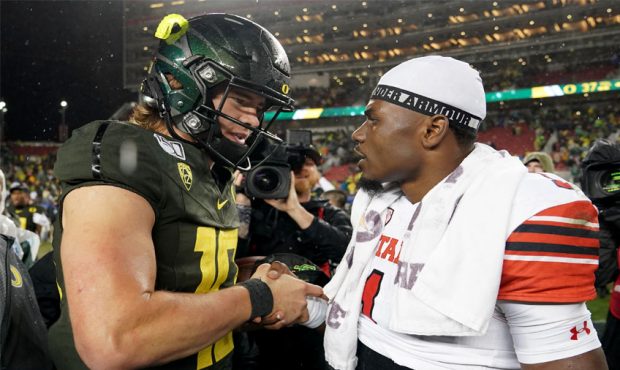
Justin Herbert #10 of the Oregon Ducks shakes hands with quarterback Tyler Huntley #1 of the Utah Utes after the Ducks defeated the Utes 37-15 in the Pac-12 Championship Game at Levi's Stadium on December 06, 2019 in Santa Clara, California. (Photo by Thearon W. Henderson/Getty Images)
(Photo by Thearon W. Henderson/Getty Images)

SALT LAKE CITY, Utah – You would think that when there is so much on the line transparency would be prioritized. Unfortunately, for college football fans around the country, and specifically Utah fans, being left in the dark is a frequent feeling.
Utah lost to Oregon 37-15 in a game that had incredibly large implications for both teams. A Pac-12 Championship was on the line, an inaugural College Football Playoff or Rose Bowl birth was also on offer.
Yet, despite the frustration of the loss ticking to boiling point for Utah fans, many also left wondering how and why two very impactful Oregon defenders were allowed to maintain their position(s) on the field.
Targeting Defined
Targeting: ARTICLE 5 a. The replay official shall review all targeting fouls, Rules
9-1-3 and 9-1-4. For a player to be disqualified and the Targeting foul to be
enforced, all elements of a Targeting foul must be confirmed by the Instant
Replay Official. There is no option for stands as a part of a Targeting review. If
any element of Targeting cannot be confirmed, then the Replay Official shall
overturn the targeting foul.
Targeting elements include:
1. Rule 9-1-3:
(a) A player takes aim at an opponent for the purposes of attacking with
forcible contact with the crown of the helmet.
(b) An indicator of targeting is present.
2. Rule 9-1-4:
(a) A defenseless opponent (Rule 2-27-14).
(b) A player takes aim at a defenseless opponent for the purposes of
attacking with forcible contact to the head or neck area.
(c) An indicator of targeting is present.
According to the 2019 NCAA Football Rules and Interpretations.
#PAC12Championship #Utah getting screwed. How is it not #targeting ??? pic.twitter.com/4y0y1YRtyY
— Marty Reynolds (@MartyReynolds) December 7, 2019
The first questionable no call came midway through the first quarter after junior safety, Brady Breeze, made “forcible contact to the head or neck area of Huntley” who was also a “defenseless” player. Huntley was falling forward, with his head faced backward. Breeze lowered his helmet during the act of the tackle.
Breeze would go on to lead the Oregon defense in tackles with nine total and six solo tackles. There is no question the Oregon defense would have suffered tremendously with the absence of Breeze, instead, he remained eligible to play.
Oregon Linebacker Troy Dye crushes Tyler Huntley.#Pac12FCG pic.twitter.com/VUHn0K7GcM
— NCAAF Nation (@NCAAFNation247) December 7, 2019
The second questionable call and the one that dumbfounded me was when senior linebacker, Troy Dye, made “forcible contact to the head or neck area” of Tyler Huntley with two and a half minutes left in the first half. Dye is seen lunging with the crown of his helmet making contact with the facemask of Tyler Huntley. The facemask, for those wondering, is considered a part of the helmet.
Huntley was not a defenseless player, as he was in the act of throwing. There was no call on the field, either. They were instead reviewing whether Jaylon Dixon caught the ball or whether or not it hit the ground.
Kyle Whittingham’s Comments
Following the second no-call on Huntley, head coach Kyle Whittingham was animated on the sideline. I asked coach as he left the field for the locker room at halftime what exactly the referees told him regarding the two no calls.
“All they told me was that neither play was deemed targeting,” Whittingham said clearly frustrated.
The Fix
There is a simple fix to help fans, players, coaches and everybody involved in college football to better understand what referees review.
You publicize the conversations that take place between the head referee and the review booth.
Following any targeting call, a review takes place. The head referee heads over to his monitor on the field, puts on the headset, and communicates with whoever is in charge of the review booth.
Giving access to the dialogue would change everything. It would allow everybody to better understand what the referees are looking at as well as giving perspective to the final call. Instead, Whittingham continues to be left in the dark.
#Utes head coach Kyle Whittingham, running back Zack Moss and safety Terrell Burgess addressing the media after Utah's disappointing loss to Oregon. https://t.co/4kU961CZ7h #Pac12FCG https://t.co/cKlXEO85wX
— KSL Sports (@kslsports) December 7, 2019
After any game that has a questionable call (there seems to be a lot of them) Whittingham sends film of the specific play to the Pac-12 to which they answer accordingly.
“They will either tell me that they got the call wrong and wish me luck next week or they will tell me that they got the call right and wish me luck next week,” Whittingham said in a recent press conference.
I also question the integrity of player safety in college football. If the NCAA is sincerely working on creating better player safety, then determining what is and what is not targeting should not be that hard. Concussions and chronic traumatic encephalopathy (CTE) has become a major issue for the NFL. The numbers in youth sports in America are alarming.

“In team sports, tackle football participation [in 2018] was down 1.3 percent overall [from 2017] with a 5.8 percent drop in core participation (26+ times a year). In the key playing age group of 6 to 17, core participation was down 3.0 percent and is now off 1.9 percent on average over the last five years,” a Forbes report from earlier this year states.
If a player makes forcible contact to the head or neck area, whether the player is deemed defenseless or not, it should be a targeting penalty. It is not rocket science.
If the NFL and NCAA are trying to eliminate concussions and head/neck injuries then they would be doing everything they can to eliminate big hits to the head/neck area and by simply stating that you cannot make contact with the head/neck area no matter the circumstance, you will change the game for the better and ultimately create a safer environment for the players.
The NCAA and the NFL are billion-dollar empires. In any NCAA or NFL game, there is always so much on the line. Yet, here we are discussing why certain decisions were made and the impact it had on a game that could have been career and program defining for the Utah football team.
Instead, we will all pretend like the game never happened and look ahead to the 2020 season in the hopes of yet another trip to the Pac-12 Championship game.